A Preview of Bristlecone, Google’s New Quantum Processor

A Preview of Bristlecone, Google’s New Quantum Processor

  • March 6, 2018
Table of Contents

A Preview of Bristlecone, Google’s New Quantum Processor

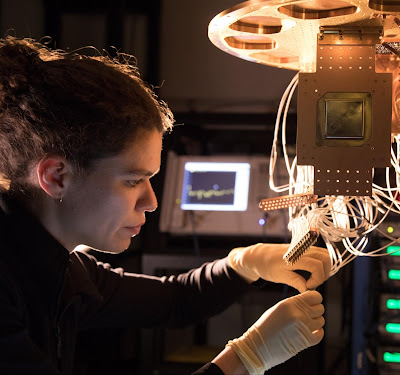
The goal of the Google Quantum AI lab is to build a quantum computer that can be used to solve real-world problems. Our strategy is to explore near-term applications using systems that are forward compatible to a large-scale universal error-corrected quantum computer. In order for a quantum processor to be able to run algorithms beyond the scope of classical simulations, it requires not only a large number of qubits.

Crucially, the processor must also have low error rates on readout and logical operations, such as single and two-qubit gate.

Source: googleblog.com

Share :
comments powered by Disqus

Related Posts

Magic Leap New Patent Applications

Magic Leap New Patent Applications

Just some quick notes to let my readers know I am in the process of digesting some new Magic Leap Patent Applications that were published last week. There are several related applications, but the most interesting one was US20180052277 MULTI-LAYER DIFFRACTIVE EYEPIECE. This application is 272 pages long, and I have only had time to flip through it, so this is all preliminary information, so I am mostly going off the figures.

Read More
Demystifying Quantum Gates — One Qubit At A Time

Demystifying Quantum Gates — One Qubit At A Time

If you want to get into quantum computing, there’s no way around it: you will have to master the cloudy concept of the quantum gate. Like everything in quantum computing, not to mention quantum mechanics, quantum gates are shrouded in an unfamiliar fog of jargon and matrix mathematics that reflects the quantum mystery. My goal in this post is to peel off a few layers of that mystery.

Read More
First firing of air-breathing Electric Truster

First firing of air-breathing Electric Truster

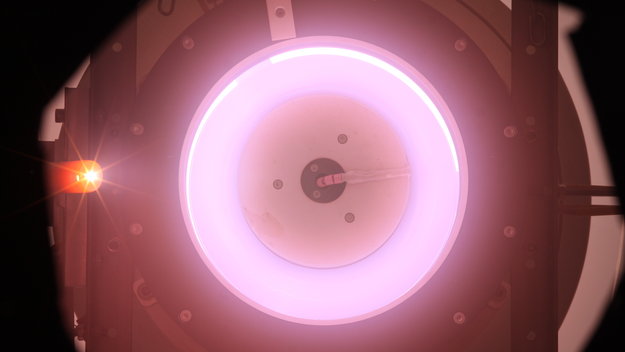
In a world-first, an ESA-led team has built and fired an electric thruster to ingest scarce air molecules from the top of the atmosphere for propellant, opening the way to satellites flying in very low orbits for years on end.

Read More