Jeff Bezos Has Spent $42M Building a Clock to Run 10,000 Years

Jeff Bezos Has Spent $42M Building a Clock to Run 10,000 Years

  • March 6, 2018
Table of Contents

Jeff Bezos Has Spent $42M Building a Clock to Run 10,000 Years

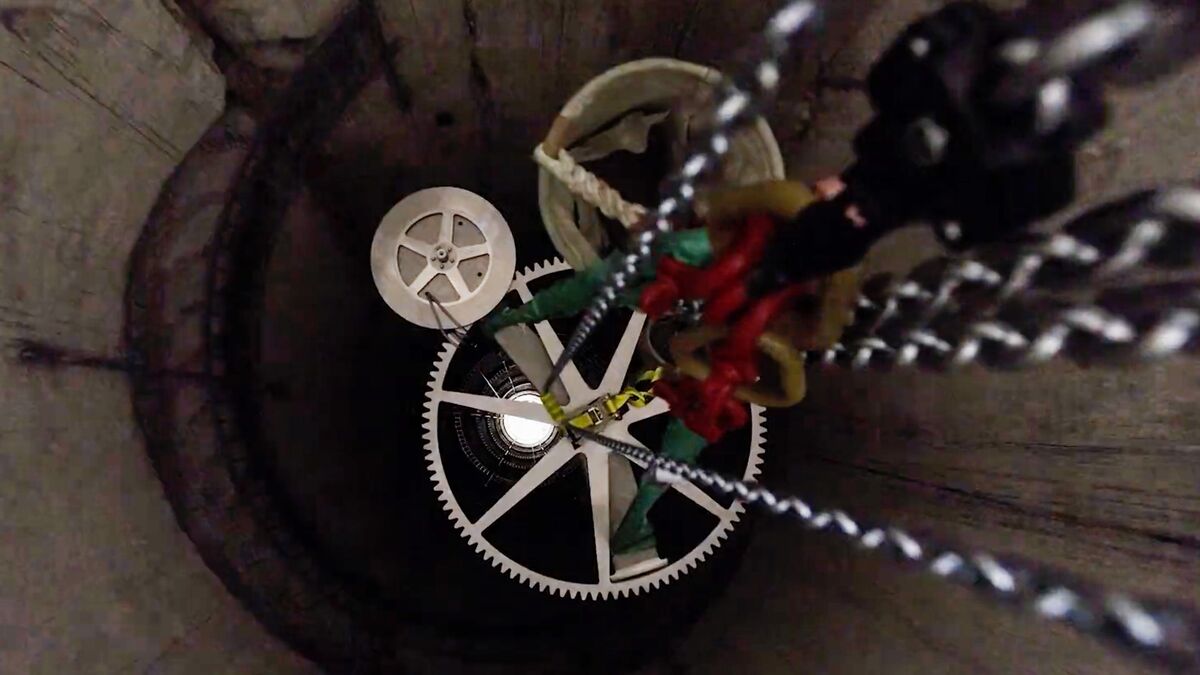
The heart of the clock is a titanium torsion pendulum that beats once every 10 seconds. The falling weight that powers the clock can be wound by hand, but it is kept wound by solar power: sunlight shines into an aperture in the 500-ft.-deep chamber in which the clock sits, striking an air-filled cylinder. The expansion of the cylinder provides enough energy to lift the falling weight slightly, and also provides a solar noon time reference for correcting the clock.

I just said that this is a grandfather clock on steroids, but really it’s more of an Atmos clock on steroids and I wonder if the Atmos might not have partially influenced the design for the Clock Of The Long Now, as two key features of the Atmos are its very slow beat (one second) torsion pendulum, and the fact that it’s kept wound by changes in temperature. And of course, there is the fact that the Atmos will keep running without human intervention, which is an essential feature for the Clock Of The Long Now.

Source: bloomberg.com
Share :
comments powered by Disqus

Related Posts

Exploring the Linguistics Behind Regular Expressions

Exploring the Linguistics Behind Regular Expressions

Little did I know that learning about Chomsky would drag me down a rabbit hole back to regular expressions, and then magically cast regular expressions into something that fascinated me. What enchanted me about regular expressions was the homonymous linguistic concept that powered them.

Read More
Insulator or superconductor? Physicists find graphene is both

Insulator or superconductor? Physicists find graphene is both

Physicists at MIT and Harvard University have found that graphene, a lacy, honeycomb-like sheet of carbon atoms, can behave at two electrical extremes: as an insulator, in which electrons are completely blocked from flowing; and as a superconductor, in which electrical current can stream through without resistance.

Read More
New Giant Viruses Further Blur the Definition of Life

New Giant Viruses Further Blur the Definition of Life

For decades, descriptions of viruses have straddled life and nonlife, a divide that usually isn’t difficult to navigate. Their hallmark characteristics, namely their small size, tiny genomes and parasitic dependence on cellular hosts for replication, set them apart from all other living things despite their animation. But that story has gotten far more puzzling — particularly since the discovery of the first giant virus in 2003, which was so large that researchers initially thought it was a bacterium.

Read More