New study tracks the evolution of stone tools

New study tracks the evolution of stone tools

  • March 7, 2018
Table of Contents

New study tracks the evolution of stone tools

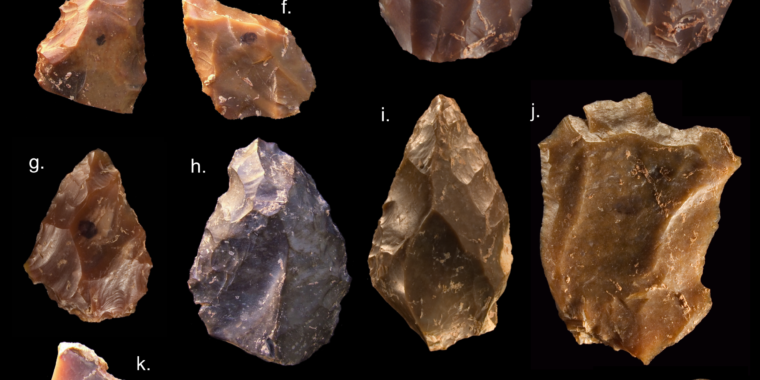
For at least 2.6 million years, humans and our ancestors have been making stone tools by chipping off flakes of material to produce sharp edges. We think of stone tools as very rudimentary technology, but producing a usable tool without wasting a lot of stone takes skill and knowledge. That’s why archaeologists tend to use the complexity of stone tools as a way to measure the cognitive skills of early humans and the complexity of their cultures and social interactions.

Source: arstechnica.com

Share :
comments powered by Disqus

Related Posts

A Preview of Bristlecone, Google’s New Quantum Processor

A Preview of Bristlecone, Google’s New Quantum Processor

The goal of the Google Quantum AI lab is to build a quantum computer that can be used to solve real-world problems. Our strategy is to explore near-term applications using systems that are forward compatible to a large-scale universal error-corrected quantum computer. In order for a quantum processor to be able to run algorithms beyond the scope of classical simulations, it requires not only a large number of qubits.

Read More
Technique to see objects hidden around corners

Technique to see objects hidden around corners

A driverless car is making its way through a winding neighborhood street, about to make a sharp turn onto a road where a child’s ball has just rolled. Although no person in the car can see that ball, the car stops to avoid it. This is because the car is outfitted with extremely sensitive laser technology that reflects off nearby objects to see around corners.

Read More
AI Researchers Aim to Crack Code on ‘Sun Energy’

AI Researchers Aim to Crack Code on ‘Sun Energy’

Since the ’50s, scientists have chased the promise of clean energy from sun-like reactions between deuterium and tritium, the plentiful isotopes of hydrogen. This carbon-free energy, achieved at temperatures of 360 million degrees Fahrenheit, would offer a great way to heat water and, in turn, spin turbines to create countless kilowatts of electricity.

Read More