Open Sourcing the Hunt for Exoplanets

Open Sourcing the Hunt for Exoplanets

  • March 8, 2018
Table of Contents

Open Sourcing the Hunt for Exoplanets

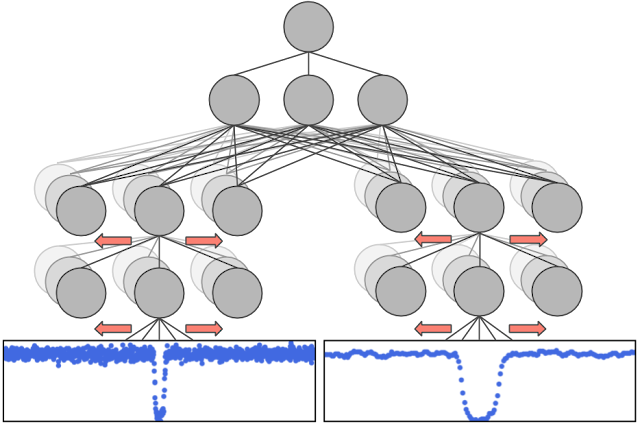
Recently, we discovered two exoplanets by training a neural network to analyze data from NASA’s Kepler space telescope and accurately identify the most promising planet signals. And while this was only an initial analysis of ~700 stars, we consider this a successful proof-of-concept for using machine learning to discover exoplanets, and more generally another example of using machine learning to make meaningful gains in a variety of scientific disciplines (e.g. healthcare, quantum chemistry, and fusion research)

Source: googleblog.com

Share :
comments powered by Disqus

Related Posts

Reptile: A Scalable Meta-Learning Algorithm

Reptile: A Scalable Meta-Learning Algorithm

We’ve developed a simple meta-learning algorithm called Reptile which works by repeatedly sampling a task, performing stochastic gradient descent on it, and updating the initial parameters towards the final parameters learned on that task. This method performs as well as MAML, a broadly applicable meta-learning algorithm, while being simpler to implement and more computationally efficient.

Read More
“Cracking” Morse code with RNNs

“Cracking” Morse code with RNNs

Spoiler alert: Morse code doesn’t really need cracking. Its useful because messages can be sent using this code with minimal equipment, and I say it doesn’t need cracking because the code is well known and what the combinations of dots and dashes stand for is no secret. But, in theory, it is a substitution cipher — where each letter of the alphabet (and each digit) has some representation using dots and dashes, as illustrated below.

Read More