Will the Quantum Nature of Gravity Finally Be Measured?

Will the Quantum Nature of Gravity Finally Be Measured?

  • March 11, 2018
Table of Contents

Will the Quantum Nature of Gravity Finally Be Measured?

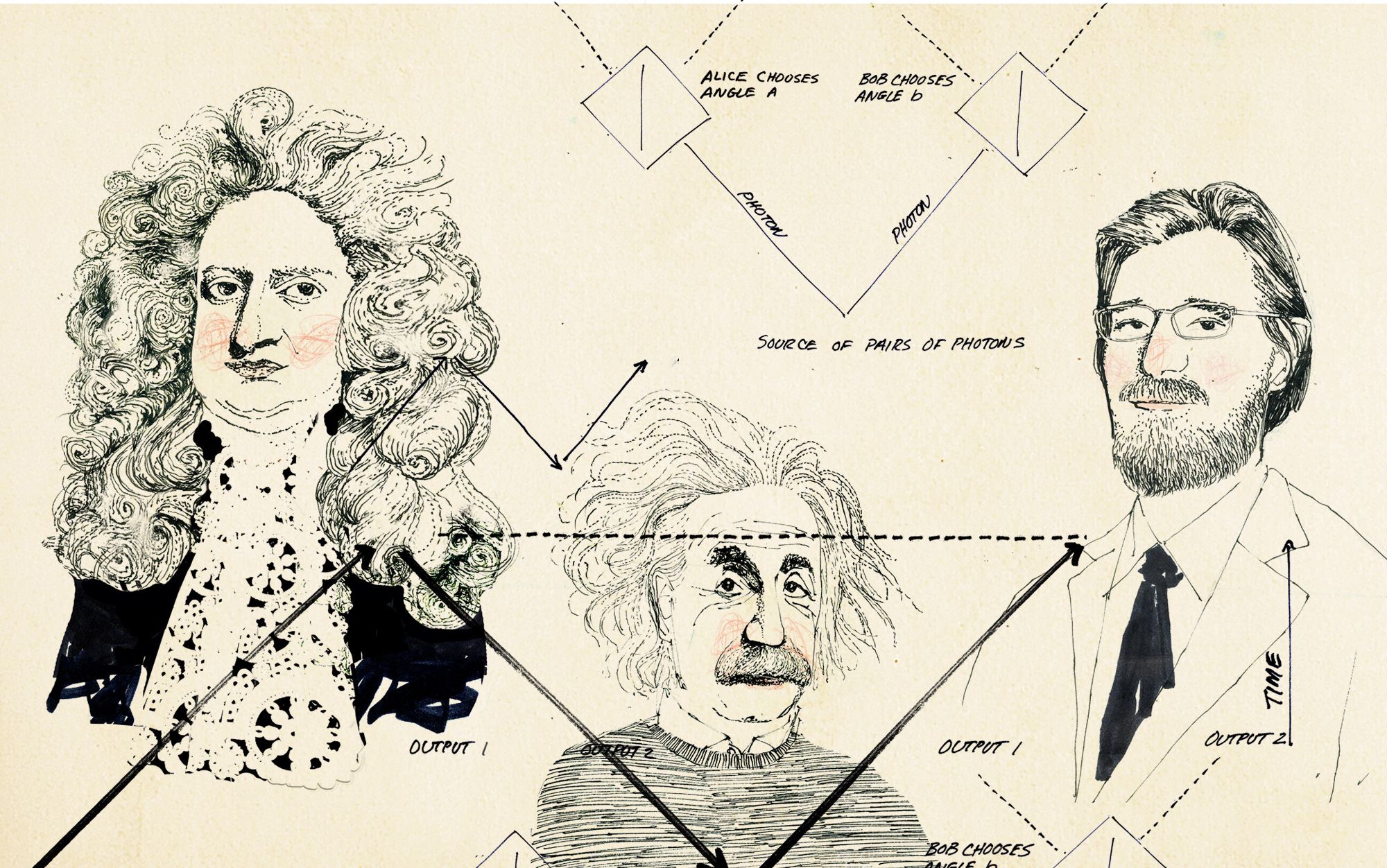
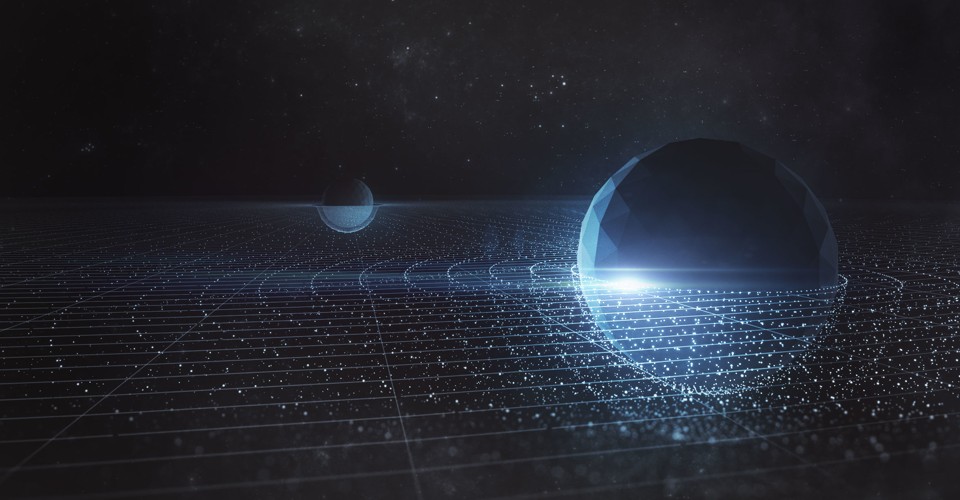
In 1935, when both quantum mechanics and Albert Einstein’s general theory of relativity were young, a little-known Soviet physicist named Matvei Bronstein, just 28 himself, made the first detailed study of the problem of reconciling the two in a quantum theory of gravity. This “possible theory of the world as a whole,” as Bronstein called it, would supplant Einstein’s classical description of gravity, which casts it as curves in the space-time continuum, and rewrite it in the same quantum language as the rest of physics.

Source: theatlantic.com
Share :
comments powered by Disqus

Related Posts

A Preview of Bristlecone, Google’s New Quantum Processor

A Preview of Bristlecone, Google’s New Quantum Processor

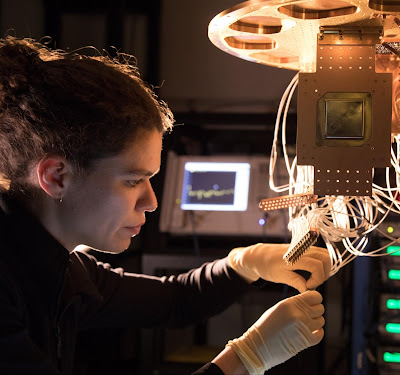
The goal of the Google Quantum AI lab is to build a quantum computer that can be used to solve real-world problems. Our strategy is to explore near-term applications using systems that are forward compatible to a large-scale universal error-corrected quantum computer. In order for a quantum processor to be able to run algorithms beyond the scope of classical simulations, it requires not only a large number of qubits.

Read More
Demystifying Quantum Gates — One Qubit At A Time

Demystifying Quantum Gates — One Qubit At A Time

If you want to get into quantum computing, there’s no way around it: you will have to master the cloudy concept of the quantum gate. Like everything in quantum computing, not to mention quantum mechanics, quantum gates are shrouded in an unfamiliar fog of jargon and matrix mathematics that reflects the quantum mystery. My goal in this post is to peel off a few layers of that mystery.

Read More
Can retrocausality solve the puzzle of action-at-a-distance?

Can retrocausality solve the puzzle of action-at-a-distance?

Einstein’s objections to quantum mechanics began very early. Schrödinger’s version of the theory introduced a new mathematical entity, the wave function, which seemed to allow the position of an unmeasured particle to be spread out across an arbitrarily large region of space. When the particle’s position was measured, the wave function was said to ‘collapse’, suddenly becoming localised where the particle was detected.

Read More