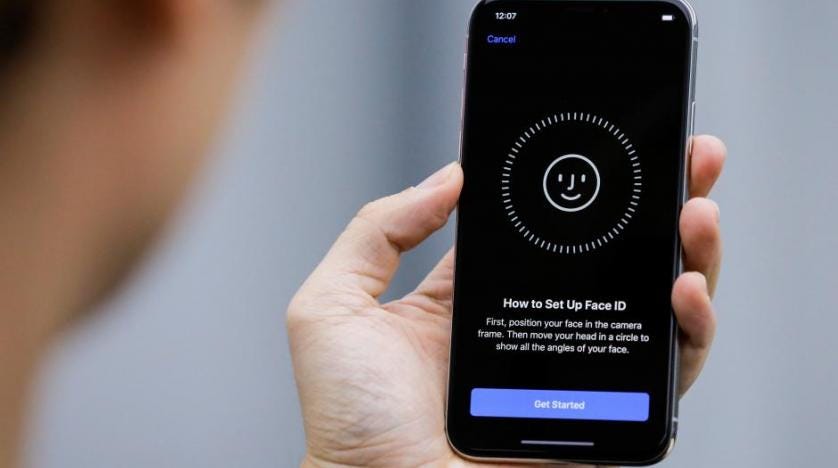
How I implemented iPhone X’s FaceID using Deep Learning in Python

How I implemented iPhone X’s FaceID using Deep Learning in Python

  • March 13, 2018
Table of Contents

How I implemented iPhone X’s FaceID using Deep Learning in Python

One of the most discussed features of the new iPhone X is the new unlocking method, the successor of TouchID: FaceID.Having created a bezel-less phone, Apple had to develop a new method to unlock the phone in a easy and fast way. While some competitors continued using a fingerprint sensor, placed in a different position, Apple decided to innovate and revolutionize the way we unlock a phone: by simply looking at it. Thanks to an advanced (and remarkably small) front facing depth-camera, iPhone X in able to create a 3D map of the face of the user.

In addition, a picture of the user’s face is captured using an infrared camera, that is more robust to changes in light and color of the environment. Using deep learning, the smartphone is able to learn the user face in great detail, thus recognizing him\her every time the phone is picked up by its owner. Surprisingly, Apple ha stated that this method is even safer than TouchID, with an outstanding error rate of 1:1,000,000.

Source: towardsdatascience.com
Tags :
Share :
comments powered by Disqus

Related Posts

PyTorch – Internal Architecture Tour

PyTorch – Internal Architecture Tour

This post is a tour around the PyTorch codebase, it is meant to be a guide for the architectural design of PyTorch and its internals. My main goal is to provide something useful for those who are interested in understanding what happens beyond the user-facing API and show something new beyond what was already covered in other tutorials.

Read More
Paper repro: “Self-Normalizing Neural Networks”

Paper repro: “Self-Normalizing Neural Networks”

SNNs are really cool: their goal is to create neural networks in which, if the input of any layer is normally distributed, the output will automatically also be normally distributed. This is amazing because normalizing the output of layers is known to be a very efficient way to improve the performance of neural networks, but the current ways to do it (eg BatchNorm) basically involve weird hacks, while in SNN the normalization is an intrinsic part of the mathematics of the neural net.

Read More
Google helps Pentagon analyze military drone footage—employees “outraged”

Google helps Pentagon analyze military drone footage—employees “outraged”

A report from Gizmodo says that Google is partnering with the United States Department of Defense and building drone software. The project will reportedly apply Google’s usual machine learning prowess to identify objects in drone footage. Google’s involvement in the project wasn’t public, but it was apparently discussed internally at Google last week and leaked.

Read More