Baidu Apollo Releases Massive Self-driving Dataset; Teams Up With Berkeley DeepDrive

Baidu Apollo Releases Massive Self-driving Dataset; Teams Up With Berkeley DeepDrive

  • March 19, 2018
Table of Contents

Baidu Apollo Releases Massive Self-driving Dataset; Teams Up With Berkeley DeepDrive

ApolloScape was released under Baidu’s autonomous driving platform Apollo, which Baidu hopes will become “the Android of the auto industry.” Apollo gives developers access to a complete set of service solutions and open-source codes and can enable for example a software engineer to convert a Lincoln MKZ into a self-driving vehicle in about 48 hours. ApolloScape’s open sourced data now provides developers a base for building self-driving vehicles.

Source: medium.com

Share :
comments powered by Disqus

Related Posts

Deciphering China’s AI Dream

Deciphering China’s AI Dream

This report examines the intersection of two subjects, China and artificial intelligence, both of which are already difficult enough to comprehend on their own. It provides context for China’s AI strategy with respect to past science and technology plans, and it also connects the consistent and new features of China’s AI approach to the drivers of AI development (e.g. hardware, data, and talented scientists). In addition, it benchmarks China’s current AI capabilities by developing a novel index to measure any country’s AI potential and highlights the potential implications of China’s AI dream for issues of AI safety, national security, economic development, and social governance.

Read More
Making music using new sounds generated with machine learning

Making music using new sounds generated with machine learning

Technology has always played a role in inspiring musicians in new and creative ways. The guitar amp gave rock musicians a new palette of sounds to play with in the form of feedback and distortion. And the sounds generated by synths helped shape the sound of electronic music.

Read More
Using Evolutionary AutoML to Discover Neural Network Architectures

Using Evolutionary AutoML to Discover Neural Network Architectures

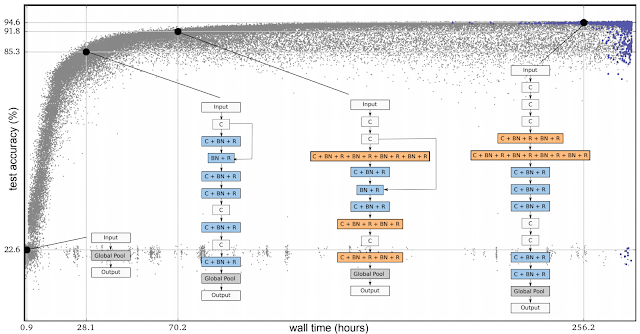
The brain has evolved over a long time, from very simple worm brains 500 million years ago to a diversity of modern structures today. The human brain, for example, can accomplish a wide variety of activities, many of them effortlessly — telling whether a visual scene contains animals or buildings feels trivial to us, for example. To perform activities like these, artificial neural networks require careful design by experts over years of difficult research, and typically address one specific task, such as to find what’s in a photograph, to call a genetic variant, or to help diagnose a disease.

Read More