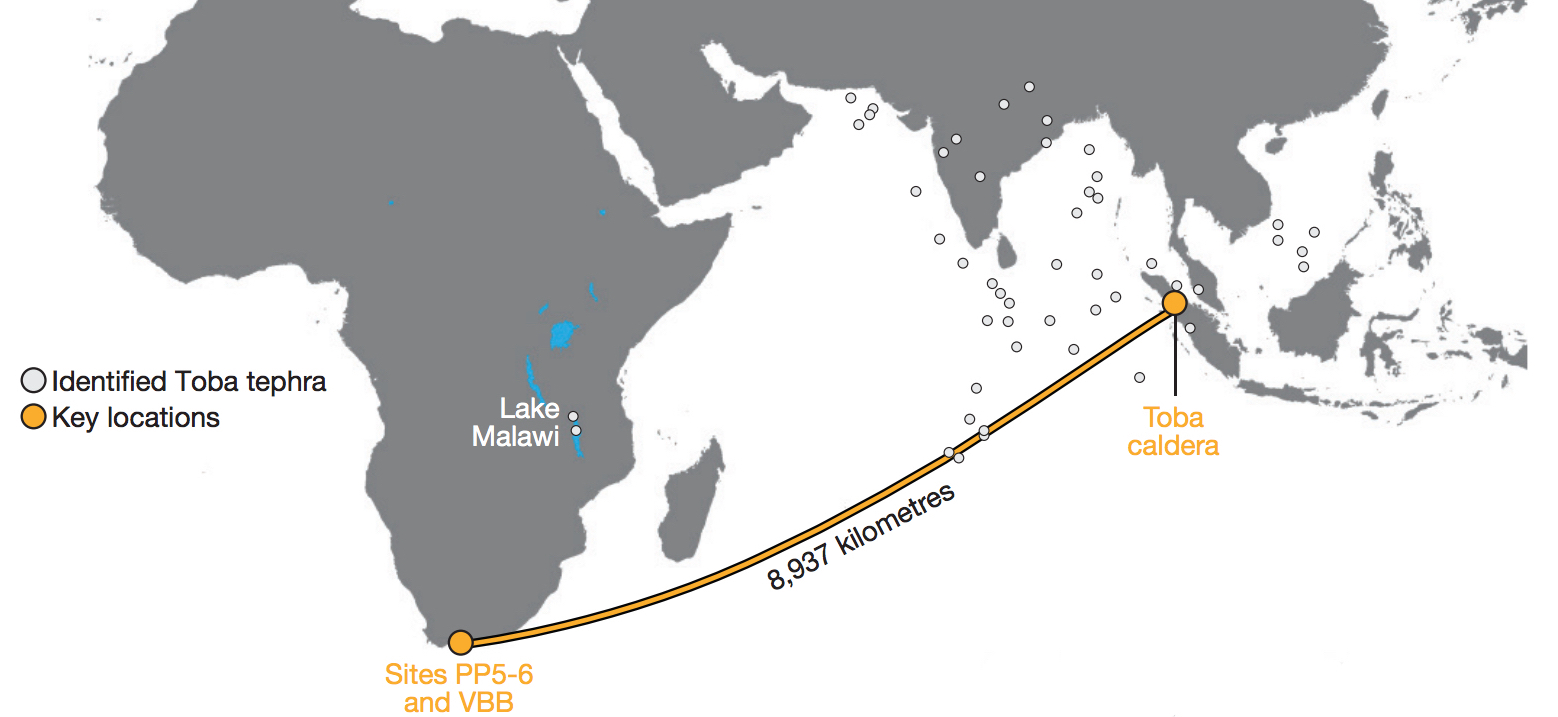
These early humans survived a supervolcano eruption 74,000 years ago

These early humans survived a supervolcano eruption 74,000 years ago

  • March 21, 2018
Table of Contents

These early humans survived a supervolcano eruption 74,000 years ago

It’s one of the biggest mysteries of recent human evolution. Roughly 70,000 years ago, Homo sapiens went through a genetic bottleneck, a period when our genetic diversity shrank dramatically. But why?

In the late 1990s, some scientists argued that the culprit was a massive volcanic eruption from what is now Lake Toba, in Sumatra, about 74,000 years ago, whose deadly effects reduced our species to a few thousand hardy individuals. Now, new evidence suggests we were right about the volcano—but wrong about pretty much everything else.

Source: arstechnica.com
Tags :
Share :
comments powered by Disqus

Related Posts

Digitising books as objects: The invisible made visible

Digitising books as objects: The invisible made visible

Technology has improved immensely since then and a lot of ‘ink’ has been spread across physical and virtual pages about the remit, the limitations and the advantages of what is offered to the public through the surrogates uploaded onto countless web portals. This piece is just another little drop into this ocean of ink to share some considerations built upon experience and from the perspective of a book conservator who sees, because of his professional background, the limitations of this, but also the exciting challenges to overcome them.

Read More
New study tracks the evolution of stone tools

New study tracks the evolution of stone tools

For at least 2.6 million years, humans and our ancestors have been making stone tools by chipping off flakes of material to produce sharp edges. We think of stone tools as very rudimentary technology, but producing a usable tool without wasting a lot of stone takes skill and knowledge. That’s why archaeologists tend to use the complexity of stone tools as a way to measure the cognitive skills of early humans and the complexity of their cultures and social interactions.

Read More
The shape of life

The shape of life

Last spring, the geobiologist Dominic Papineau and colleagues reported that fossilised microorganisms were identified in 3.77-4.28-billion-year-old iron-rich rock in Quebec: hematite tubes and filaments whose appearance is similar to microorganisms that today live in hydrothermal vents. Others dismissed their findings as ‘dubiofossils’, a term the geologist Hans Hofmann coined in 1972 to describe controversial fossils. ‘Fossils,’ Hofmann wrote, were proven biological; ‘pseudofossils’ resembled life but were inorganic; ‘dubiofossils’ (also known as Problematica or Miscellanea) were equivocal.

Read More