Porous silk fiber traps heat, hides a rabbit from IR camera

Porous silk fiber traps heat, hides a rabbit from IR camera

  • April 5, 2018
Table of Contents

Porous silk fiber traps heat, hides a rabbit from IR camera

To mimic polar bear hair and to turn it into a weavable thread, the researchers turned to another natural fiber: silk. Instead of using the silk fiber directly, the silk was purified and dissolved in a liquid. The solution was then spun and extruded through a ring that was cooled.

The idea is that the cold ring freezes the silk as it passes through. Depending on the temperature of the ring and the speed at which the fiber is drawn through the ring, however, the silk can start to freeze before it reaches the ring. So researchers tried to hit a sweet spot in balancing temperature and draw speed.

If the ring is too cold, everything freezes in place and the pores will be oriented in random directions. If the ring is not cold enough, then the silk protein has time to close up and remove the pores entirely.

Source: arstechnica.com
Share :
comments powered by Disqus

Related Posts

A Preview of Bristlecone, Google’s New Quantum Processor

A Preview of Bristlecone, Google’s New Quantum Processor

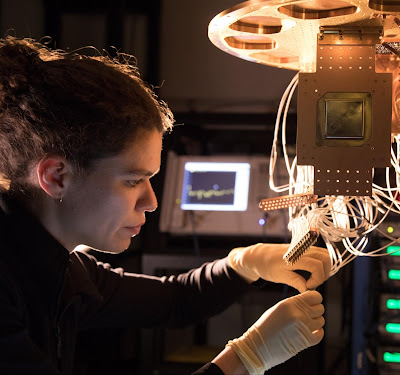
The goal of the Google Quantum AI lab is to build a quantum computer that can be used to solve real-world problems. Our strategy is to explore near-term applications using systems that are forward compatible to a large-scale universal error-corrected quantum computer. In order for a quantum processor to be able to run algorithms beyond the scope of classical simulations, it requires not only a large number of qubits.

Read More
Is Google Going Underground with Hypersonic Tech?

Is Google Going Underground with Hypersonic Tech?

Google is carrying out research on hypersonics, probably for new technologies to slash the cost of geothermal energy and tunneling. It could also be acquiring a Washington-based startup called HyperSciences that has already built prototype devices.

Read More
New study tracks the evolution of stone tools

New study tracks the evolution of stone tools

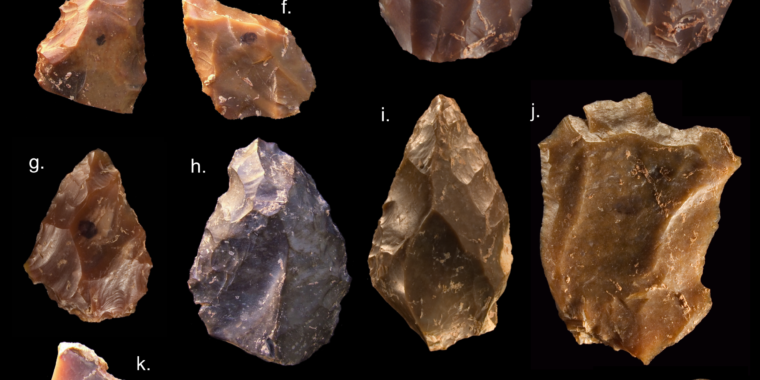
For at least 2.6 million years, humans and our ancestors have been making stone tools by chipping off flakes of material to produce sharp edges. We think of stone tools as very rudimentary technology, but producing a usable tool without wasting a lot of stone takes skill and knowledge. That’s why archaeologists tend to use the complexity of stone tools as a way to measure the cognitive skills of early humans and the complexity of their cultures and social interactions.

Read More