Towards a Virtual Stuntman

Towards a Virtual Stuntman

  • April 12, 2018
Table of Contents

Towards a Virtual Stuntman

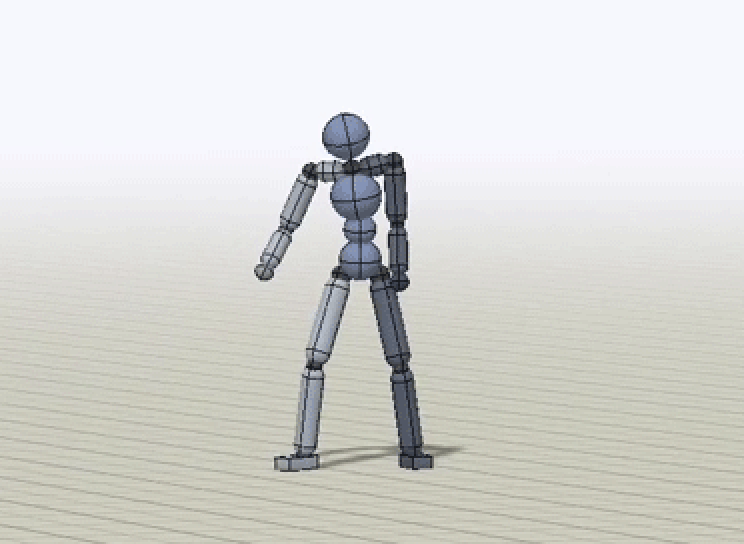
Motion control problems have become standard benchmarks for reinforcement learning, and deep RL methods have been shown to be effective for a diverse suite of tasks ranging from manipulation to locomotion. However, characters trained with deep RL often exhibit unnatural behaviours, bearing artifacts such as jittering, asymmetric gaits, and excessive movement of limbs. Can we train our characters to produce more natural behaviours?

Source: berkeley.edu
Tags :
Share :
comments powered by Disqus

Related Posts

Differentiable Plasticity: A New Method Learning to Learn

Differentiable Plasticity: A New Method Learning to Learn

Neural networks, which underlie many of Uber’s machine learning systems, have proven highly successful in solving complex problems, including image recognition, language understanding, and game-playing. However, these networks are usually trained to a stopping point through gradient descent, which incrementally adjusts the connections of the network based on its performance over many trials. Once the training is complete, the network is fixed and the connections can no longer change; as a result, barring any later re-training (again requiring many examples), the network in effect stops learning at the moment training ends.

Read More
AlterEgo: Interfacing with devices through silent speech

AlterEgo: Interfacing with devices through silent speech

AlterEgo is a closed-loop, non-invasive, wearable system that allows humans to converse in high-bandwidth natural language with machines, artificial intelligence assistants, services, and other people without any voice—without opening their mouth, and without any discernible movements—simply by vocalizing internally.

Read More