A physical constant’s value shouldn’t depend on how you measure it

A physical constant’s value shouldn’t depend on how you measure it

  • April 14, 2018
Table of Contents

A physical constant’s value shouldn’t depend on how you measure it

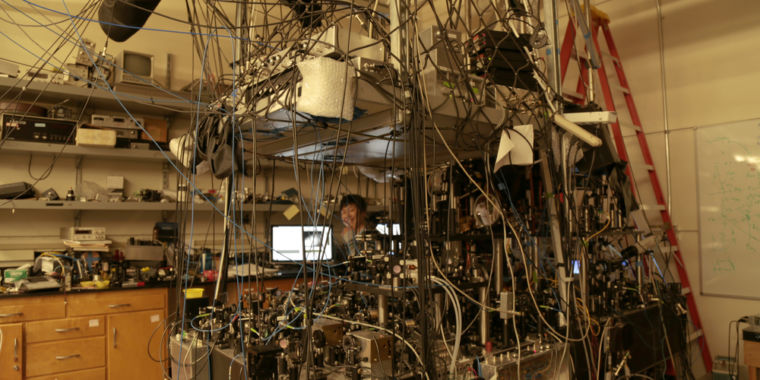
Measurements in physics are funny things. You’d hope that attempts to quantify some of the fundamental properties of the Universe would follow a simple pattern: they’d start with large error bars, but, over time, measuring technology improves and the error bars shrink. Ideally, the value would then remain nicely within the previous error.

Source: arstechnica.com

Tags :
Share :
comments powered by Disqus

Related Posts

We Still Don’t Understand Why Time Only Flows Forward

We Still Don’t Understand Why Time Only Flows Forward

Every moment that passes finds us traveling from the past to the present and into the future, with time always flowing in the same direction. At no point does it ever appear to either stand still or reverse; the “arrow of time” always points forwards for us. But if we look at the laws of physics—from Newton to Einstein, from Maxwell to Bohr, from Dirac to Feynman—they appear to be time-symmetric.

Read More
Dark Matter Is in Our DNA

Dark Matter Is in Our DNA

While some point to galaxy cluster work by Fritz Zwicky in the 1930s, dark matter was truly “discovered” in the 1970s by Vera Rubin, who was studying the rotation of spiral galaxies. Rubin found that galaxies were spinning too fast for the matter we could see in them, yet they weren’t flying apart. Rubin’s work left astronomers with a choice: Either our laws of gravity were wrong, or there was something else out there pulling on the galaxy’s stars and speeding them up while keeping them together.

Read More