NASA’s Got a Plan for a ‘Galactic Positioning System’ to Save Astronauts Lost in Space

NASA’s Got a Plan for a ‘Galactic Positioning System’ to Save Astronauts Lost in Space

  • April 17, 2018
Table of Contents

NASA’s Got a Plan for a ‘Galactic Positioning System’ to Save Astronauts Lost in Space

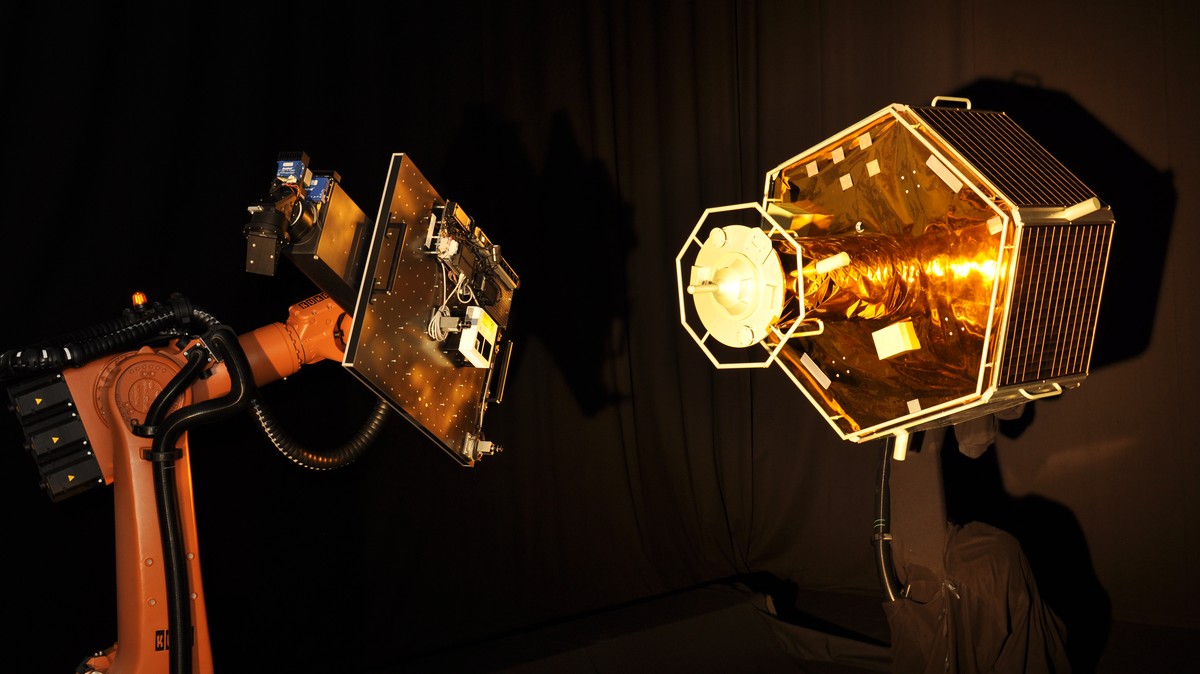
Your phone’s GPS works fast, but Arzoumian said the galactic positioning system would work slower —taking the time needed to traverse long stretches of deep space. It would be a small, swivel-mounted X-ray telescope, which would look a lot like the big, bulky NICER stripped down to its barest minimum components. One after another, it would point at at least four millisecond pulsars, timing their X-ray ‘ticks’ like a GPS times the ticks of satellites.

Three of those pulsars would tell the spacecraft its position in space, while the fourth would calibrate its internal clock to make sure it was measuring the others properly.

Source: livescience.com
Tags :
Share :
comments powered by Disqus

Related Posts

Voyager 1 Fires Up Thrusters After 37 Years

Voyager 1 Fires Up Thrusters After 37 Years

Thethrusters aboard the Voyager 1 spacecraft just did what we thought was impossible. After 37 years of inactivity,NASA just received response from spacecraft 13 billion miles away, NASA said in a statement on its website. Voyager 1 is NASA’s farthest and fastest spacecraft.

Read More
Breakthrough Announced in Dark Matter Detection Technology

Breakthrough Announced in Dark Matter Detection Technology

This week, the Axion Dark Matter Experiment (ADMX) unveiled a new result, published in the journal Physical Review Letters, that places it in a category of one: it is the world’s first and only experiment to have achieved the necessary sensitivity to “hear” the telltale signs of dark matter axions. This technological breakthrough is the result of more than 30 years of research and development, with the latest piece of the puzzle coming in the form of a quantum-enabled device that allows ADMX to listen for axions more closely than any experiment ever built.

Read More
Rolls-Royce and Boeing invest in UK space engine

Rolls-Royce and Boeing invest in UK space engine

Key technologies include a compact pre-cooler heat-exchanger that can take an incoming airstream of over 1,000C and cool it to -150C in less than 1/100th of a second. This would permit Sabre to use oxygen direct from the atmosphere for combustion instead of carrying it in a tank with the weight penalty that implies.

Read More