Measuring the Intrinsic Dimension of Objective Landscapes

Measuring the Intrinsic Dimension of Objective Landscapes

  • April 27, 2018
Table of Contents

Measuring the Intrinsic Dimension of Objective Landscapes

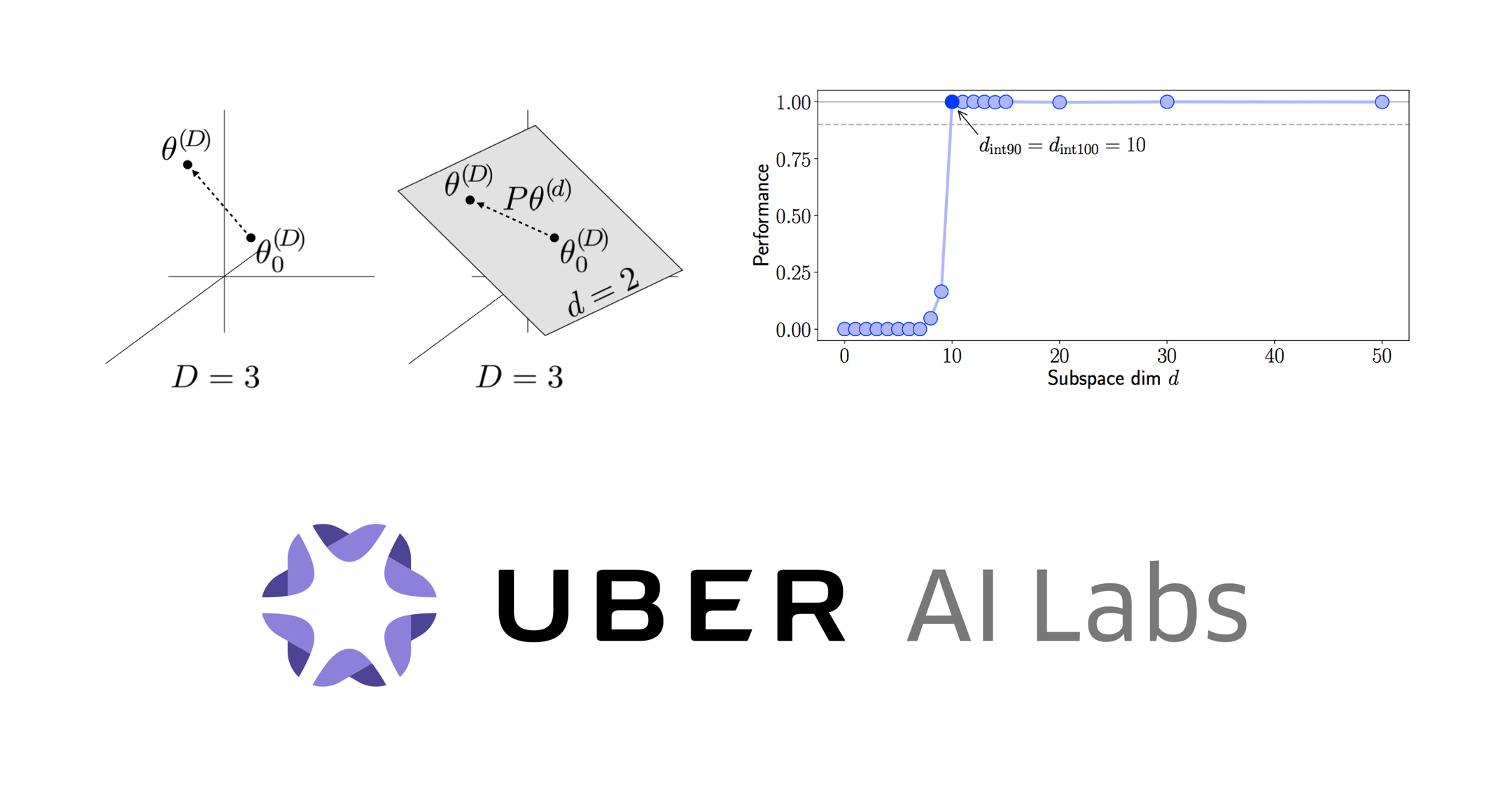
In our paper, Measuring the Intrinsic Dimension of Objective Landscapes, to be presented at ICLR 2018, we contribute to this ongoing effort by developing a simple way of measuring a fundamental network property known as intrinsic dimension. In the paper, we develop intrinsic dimension as a quantification of the complexity of a model in a manner decoupled from its raw parameter count, and we provide a simple way of measuring this dimension using random projections. We find that many problems have smaller intrinsic dimension than one might suspect.

By using intrinsic dimension to compare across problem domains, we measure, for example, that solving the inverted pendulum problem is about 100 times easier than classifying digits from MNIST, and playing Atari Pong from pixels is about as hard as classifying CIFAR-10.

Source: uber.com

Tags :
Share :
comments powered by Disqus

Related Posts

Swift for TensorFlow Design Overview

Swift for TensorFlow Design Overview

Swift for TensorFlow provides a new programming model for TensorFlow – one that combines the performance of graphs with the flexibility and expressivity of Eager execution, while keeping a strong focus on improved usability at every level of the stack. In order to achieve our goals, we scope in the possibility of making (carefully considered) compiler and language enhancements, which enables us to provide a great user experience.

Read More
Pentagon-funded research aims to predict when crimes are gang-related

Pentagon-funded research aims to predict when crimes are gang-related

The paper attempts to predict whether crimes are gang-related using a neural network, a complex computational system modeled after a human brain that “learns” to classify or identify items based on ingesting a training dataset. The authors selected what they determined to be the four most important features (number of suspects, primary weapon used, the type of premises where the crime took place, and the narrative description of the crime) for identifying a gang-related crime from 2014–16 LAPD data and cross-referenced the crime incidents with a 2009 LAPD map of gang territory to create a training dataset for their neural network.

Read More