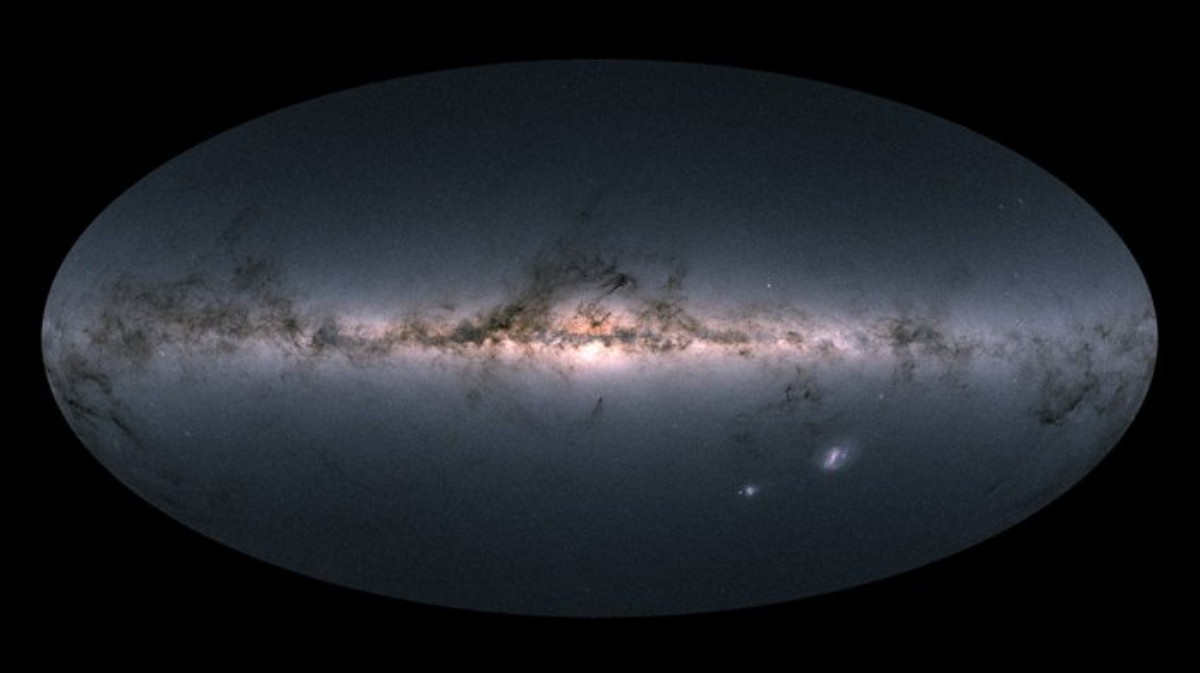
Watch These Stunning Models of the Largest Star Map Ever Created

Watch These Stunning Models of the Largest Star Map Ever Created

  • April 27, 2018
Table of Contents

Watch These Stunning Models of the Largest Star Map Ever Created

Since its launch in December 2013, the European Space Agency’s Gaia observatory has been building the largest and most detailed 3D star catalog in history. Located some 1.5 million kilometers (932,000 miles) from Earth, the telescope constantly scans our solar system, the Milky Way galaxy, and the wider universe beyond, to log information about the billions of stars and other objects that inhabit these cosmic frontiers.

Source: vice.com

Tags :
Share :
comments powered by Disqus

Related Posts

Breakthrough Announced in Dark Matter Detection Technology

Breakthrough Announced in Dark Matter Detection Technology

This week, the Axion Dark Matter Experiment (ADMX) unveiled a new result, published in the journal Physical Review Letters, that places it in a category of one: it is the world’s first and only experiment to have achieved the necessary sensitivity to “hear” the telltale signs of dark matter axions. This technological breakthrough is the result of more than 30 years of research and development, with the latest piece of the puzzle coming in the form of a quantum-enabled device that allows ADMX to listen for axions more closely than any experiment ever built.

Read More
Nobody Knows How This Part of Mars Exploded

Nobody Knows How This Part of Mars Exploded

On the scarred terrain of Arabia Terra, a region on Mars that serves as the setting for The Martian, lies a mysterious pockmark known as Ismenia Patera. New imagery released by the European Space Agency (ESA) on Thursday reveals dimensions of this feature that help contextualize its geological evolution (though its origins remain unresolved).

Read More
Improved Hubble data provide fresh evidence for new physics

Improved Hubble data provide fresh evidence for new physics

Measurements made by the European Space Agency’s Planck satellite, which maps the cosmic microwave background, predicted that the Hubble constant value should now be 67 kilometers per second per megaparsec (3.3 million light-years), and could be no higher than 69 kilometers per second per megaparsec. This means that for every 3.3 million light-years farther away a galaxy is from us, it is moving 67 kilometers per second faster. But Riess’s team measured a value of 73 kilometers per second per megaparsec, indicating galaxies are moving at a faster rate than implied by observations of the early universe.

Read More