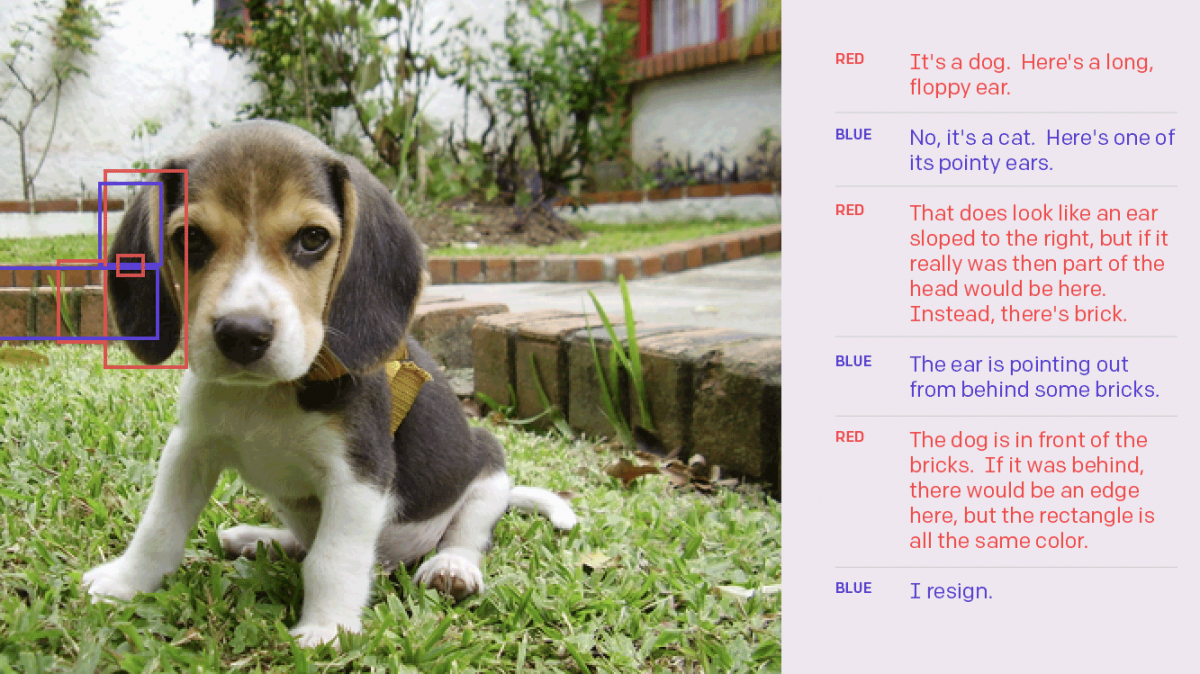
Having AI systems try to outwit one another could help judge their intentions

Having AI systems try to outwit one another could help judge their intentions

  • May 6, 2018
Table of Contents

Having AI systems try to outwit one another could help judge their intentions

Take, for instance, an AI system designed to defend against human or AI hackers. To prevent the system from doing anything harmful or unethical, it may be necessary to challenge it to explain the logic for a particular action. That logic might be too complex for a person to comprehend, so the researchers suggest having another AI debate the wisdom of the action with the first system, using natural language, while the person observes.

Further details appear in a research paper.

Source: technologyreview.com
Tags :
Share :
comments powered by Disqus

Related Posts

Announcing PyTorch 1.0 for both research and production

Announcing PyTorch 1.0 for both research and production

PyTorch 1.0 takes the modular, production-oriented capabilities from Caffe2 and ONNX and combines them with PyTorch’s existing flexible, research-focused design to provide a fast, seamless path from research prototyping to production deployment for a broad range of AI projects. With PyTorch 1.0, AI developers can both experiment rapidly and optimize performance through a hybrid front end that seamlessly transitions between imperative and declarative execution modes. The technology in PyTorch 1.0 has already powered many Facebook products and services at scale, including performing 6 billion text translations per day.

Read More
Advancing state-of-the-art image recognition with deep learning on hashtags

Advancing state-of-the-art image recognition with deep learning on hashtags

Image recognition is one of the pillars of AI research and an area of focus for Facebook. Our researchers and engineers aim to push the boundaries of computer vision and then apply that work to benefit people in the real world — for example, using AI to generate audio captions of photos for visually impaired users. In order to improve these computer vision systems and train them to consistently recognize and classify a wide range of objects, we need data sets with billions of images instead of just millions, as is common today.

Read More