Real-Time AI: Microsoft Announces Preview of Project Brainwave

Real-Time AI: Microsoft Announces Preview of Project Brainwave

  • May 8, 2018
Table of Contents

Real-Time AI: Microsoft Announces Preview of Project Brainwave

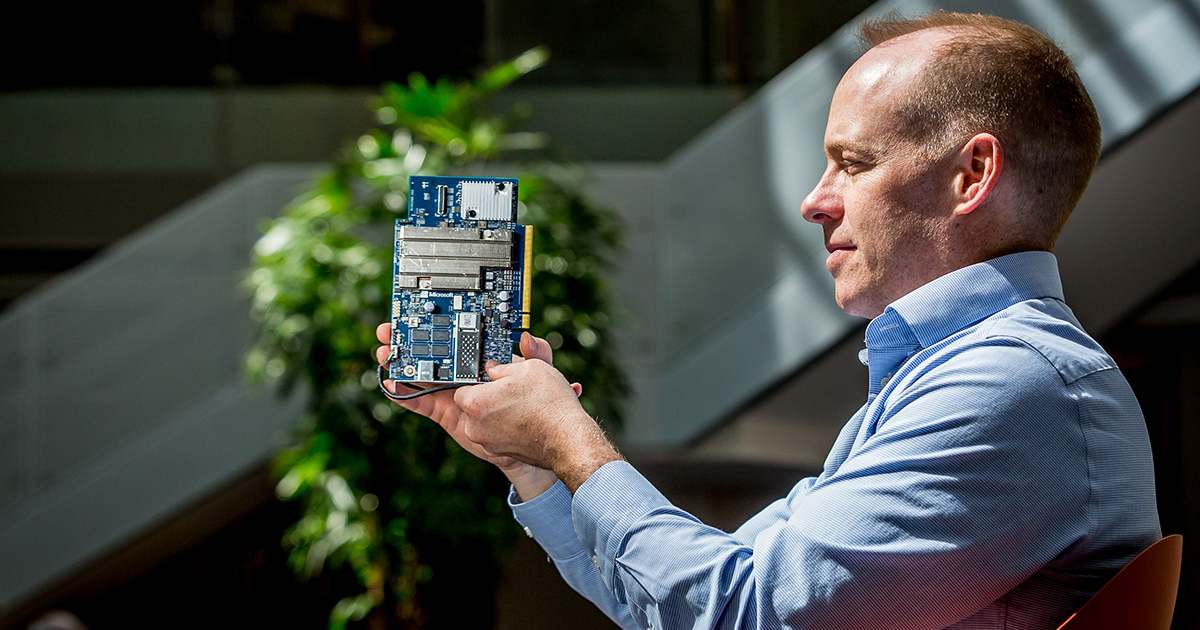
That’s where Microsoft’s Project Brainwave could come in. Project Brainwave is a hardware architecture designed to accelerate real-time AI calculations. The Project Brainwave architecture is deployed on a type of computer chip from Intel called a field programmable gate array, or FPGA, to make real-time AI calculations at competitive cost and with the industry’s lowest latency, or lag time.

This is based on internal performance measurements and comparisons to other organization’s publicly posted information. The Project Brainwave preview includes the ability for customers to do ultra-fast image recognition for applications such as the one Jabil is piloting, and it lets people do AI-based computations in real time, instead of batching it into smaller groups of separate computations. It works on TensorFlow, one of the most commonly used frameworks for doing AI calculations using deep neural networks, a method that is roughly modeled on theories about how the brain works.

In addition, Microsoft is working on building the capability to support Microsoft Cognitive Toolkit, another popular framework for deep learning.

Source: microsoft.com

Tags :
Share :
comments powered by Disqus

Related Posts

ONNX expansion speeds AI development

ONNX expansion speeds AI development

Facebook helped develop the Open Neural Network Exchange (ONNX) format to allow AI engineers to more easily move models between frameworks without having to do resource-intensive custom engineering. Today, we’re sharing that ONNX is adding support for additional AI tools, including Apple Core ML converter technology, Baidu’s PaddlePaddle platform, and Qualcomm SNPE.

Read More
Announcing PyTorch 1.0 for both research and production

Announcing PyTorch 1.0 for both research and production

PyTorch 1.0 takes the modular, production-oriented capabilities from Caffe2 and ONNX and combines them with PyTorch’s existing flexible, research-focused design to provide a fast, seamless path from research prototyping to production deployment for a broad range of AI projects. With PyTorch 1.0, AI developers can both experiment rapidly and optimize performance through a hybrid front end that seamlessly transitions between imperative and declarative execution modes. The technology in PyTorch 1.0 has already powered many Facebook products and services at scale, including performing 6 billion text translations per day.

Read More