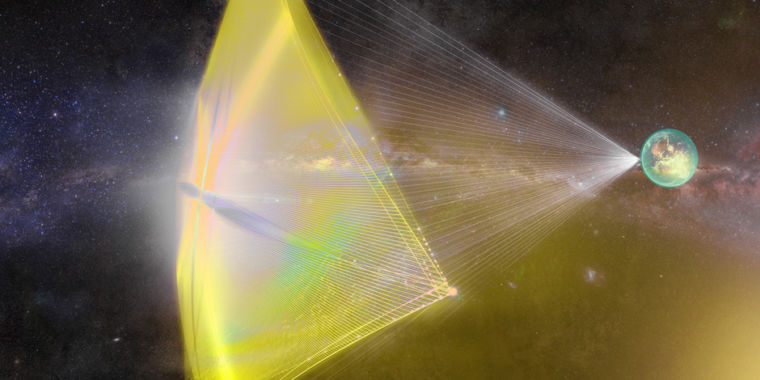
The material science of building a light sail to take us to Alpha Centauri

The material science of building a light sail to take us to Alpha Centauri

  • May 8, 2018
Table of Contents

The material science of building a light sail to take us to Alpha Centauri

It has been about two years since Yuri Milner announced his most audacious piece of science-focused philanthropy: Breakthrough Starshot, an attempt to send hardware to Alpha Centauri by mid-century. Although the technology involved is a reasonable extrapolation of things we already know how to make, being able to create materials and technology that create that extrapolation is a serious challenge. So much of Breakthrough Starshot’s early funding has gone to figuring out what improvements on current technology are needed.

Perhaps the least well-understood developments we need come in the form of the light sail that will be needed to accelerate the starshots to 20 percent of the speed of light. We’ve only put two examples of light-driven sails into space, and they aren’t anything close to what is necessary for Breakthrough Starshot. So, in this week’s edition of Nature Materials, a team of Caltech scientists looks at what we’d need to do to go from those examples to something capable of interstellar travel.

Source: arstechnica.com

Tags :
Share :
comments powered by Disqus

Related Posts

For the first time, two CubeSats have gone interplanetary

For the first time, two CubeSats have gone interplanetary

The first CubeSats launched in 2003, and in less than a decade, more than 100 had reached orbit around Earth. The aerospace industry has debated whether the 2kg to 15kg microsatellites are a fad, a toy, or a disruptive technology that will change the way we ultimately observe and study Earth and the rest of the Solar System. However, what is now beyond doubt is that the first CubeSats have gone interplanetary.

Read More
Mining in Space Could Lead to Conflicts on Earth

Mining in Space Could Lead to Conflicts on Earth

Space mining is no longer science fiction. By the 2020s, Planetary Resources and Deep Space Industries—for-profit space-mining companies cooperating with NASA—will be sending out swarms of tiny satellites to assess the composition of hurtling hunks of cosmic debris, identify the most lucrative ones, and harvest them. They’ve already developed prototype spacecraft to do the job.

Read More