The material science of building a light sail to take us to Alpha Centauri

The material science of building a light sail to take us to Alpha Centauri

  • May 8, 2018
Table of Contents

The material science of building a light sail to take us to Alpha Centauri

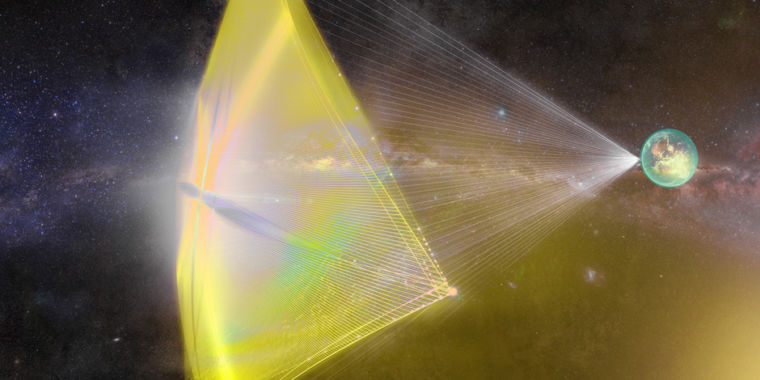
It has been about two years since Yuri Milner announced his most audacious piece of science-focused philanthropy: Breakthrough Starshot, an attempt to send hardware to Alpha Centauri by mid-century. Although the technology involved is a reasonable extrapolation of things we already know how to make, being able to create materials and technology that create that extrapolation is a serious challenge. So much of Breakthrough Starshot’s early funding has gone to figuring out what improvements on current technology are needed.

Perhaps the least well-understood developments we need come in the form of the light sail that will be needed to accelerate the starshots to 20 percent of the speed of light. We’ve only put two examples of light-driven sails into space, and they aren’t anything close to what is necessary for Breakthrough Starshot. So, in this week’s edition of Nature Materials, a team of Caltech scientists looks at what we’d need to do to go from those examples to something capable of interstellar travel.

Source: arstechnica.com
Tags :
Share :
comments powered by Disqus

Related Posts

New Shepard flies again, bringing suborbital space tourism closer

New Shepard flies again, bringing suborbital space tourism closer

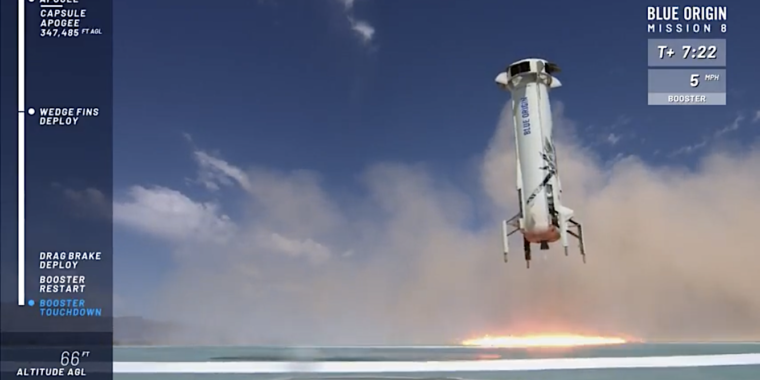
Sunday’s flight was Blue Origin’s eighth overall launch of the New Shepard system and the second time this particular spacecraft and booster have flown. They last flew in December. It is believed that this capsule, the third one built by the company, will undergo extensive testing before crew flights begin in the fourth vehicle.

Read More
NASA completes full-power tests of small, portable nuclear reactor

NASA completes full-power tests of small, portable nuclear reactor

Being able to generate power will be essential for long-term space travel. Powering a stay on Mars, for example, will require a lot of fuel, way more than we can pack onto a rocket. That’s why NASA, Los Alamos National Laboratory, the Department of Energy and a number of other groups have been working on a small, transportable nuclear reactor that can reliably generate power on the go.

Read More
Mining in Space Could Lead to Conflicts on Earth

Mining in Space Could Lead to Conflicts on Earth

Space mining is no longer science fiction. By the 2020s, Planetary Resources and Deep Space Industries—for-profit space-mining companies cooperating with NASA—will be sending out swarms of tiny satellites to assess the composition of hurtling hunks of cosmic debris, identify the most lucrative ones, and harvest them. They’ve already developed prototype spacecraft to do the job.

Read More