Automatic Photography with Google Clips

Automatic Photography with Google Clips

  • May 12, 2018
Table of Contents

Automatic Photography with Google Clips

How could we train an algorithm to recognize interesting moments? As with most machine learning problems, we started with a dataset. We created a dataset of thousands of videos in diverse scenarios where we imagined Clips being used.

We also made sure our dataset represented a wide range of ethnicities, genders, and ages. We then hired expert photographers and video editors to pore over this footage to select the best short video segments. These early curations gave us examples for our algorithms to emulate.

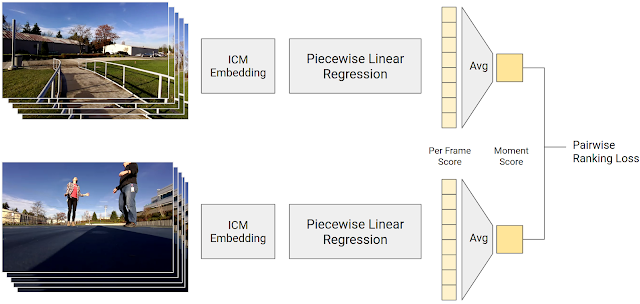
However, it is challenging to train an algorithm solely from the subjective selection of the curators — one needs a smooth gradient of labels to teach an algorithm to recognize the quality of content, ranging from ‘perfect’ to ‘terrible.’ To address this problem, we took a second data-collection approach, with the goal of creating a continuous quality score across the length of a video. We split each video into short segments (similar to the content Clips captures), randomly selected pairs of segments, and asked human raters to select the one they prefer.

Source: googleblog.com

Tags :
Share :
comments powered by Disqus

Related Posts

AI Can Generate ‘Doom’ Levels Now

AI Can Generate ‘Doom’ Levels Now

Researchers recently successfully trained neural networks to generate level maps for Doom that, they report in a paper published to the arXiv preprint server in April, “proved to be interesting” to play. The work was carried out by researchers from the Polytechnic University of Milan and used Generative Adversarial Networks, a recent innovation in the field of deep learning.

Read More
Intel Starts R&D Effort in Probabilistic Computing for AI

Intel Starts R&D Effort in Probabilistic Computing for AI

Intel announced today that it is forming a strategic research alliance to take artificial intelligence to the next level. Autonomous systems don’t have good enough ways to respond to the uncertainties of the real world, and they don’t have a good enough way to understand how the uncertainties of their sensors should factor into the decisions they need to make. According to Intel CTO Mike Mayberry the answer is “probabilistic computing”, which he says could be AI’s next wave.

Read More