What’s New in Deep Learning Research: Inside Google’s Semantic Experiences

What’s New in Deep Learning Research: Inside Google’s Semantic Experiences

  • May 14, 2018
Table of Contents

What’s New in Deep Learning Research: Inside Google’s Semantic Experiences

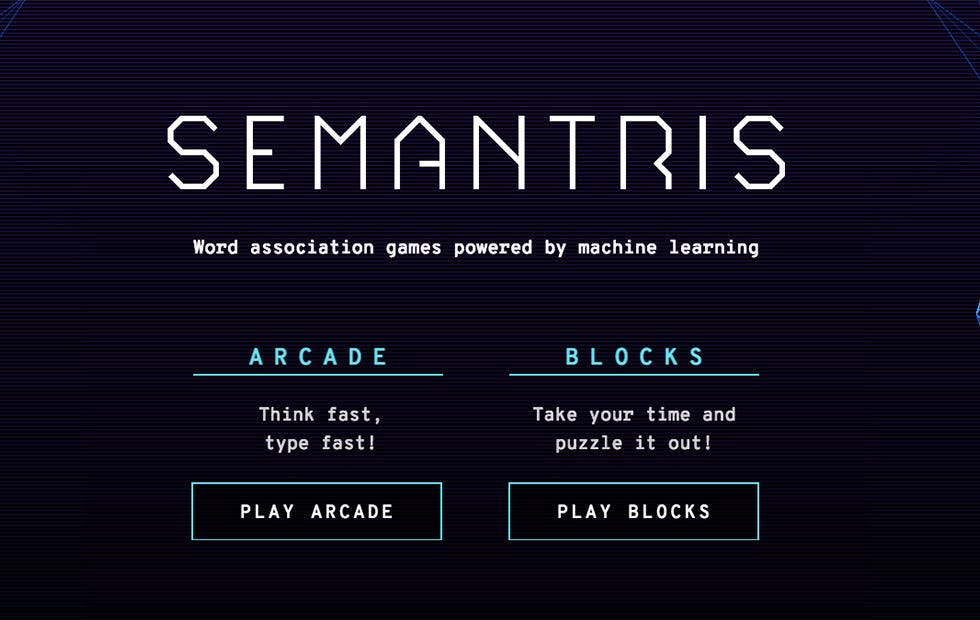
Last week Google Research made news with the release of Semantic Experiences, a website that serves as a playground to evaluate some of the new advancements in natural language understanding(NLU) technologies. The initial release included two pseudo-games that illustrates the practical viability of some of Google’s latest NLU research. The second initiatives included in Semantic Experiences is Semantris, a game powered by machine learning, where you type out words associated with a given prompt.

The experience might seem trivial but, speaking as an end user, I can tell you it can become addictive. Google’s Talk to Books and Semantris are both the first practical implementations of the Universal Sentence Encoder technique. This method was recently outlined in a paper published by a team of researchers at Google that includes world-renown author and futurist Ray Kurzweil.

Conceptually, the Universal Sentence Encoder technique focuses on representing language in a vector space using vectors that represents large text sections such as sentences or paragraphs vs. the traditional models that focused mostly on word vectors.

Source: towardsdatascience.com
Tags :
Share :
comments powered by Disqus

Related Posts

Automatic Photography with Google Clips

Automatic Photography with Google Clips

How could we train an algorithm to recognize interesting moments? As with most machine learning problems, we started with a dataset. We created a dataset of thousands of videos in diverse scenarios where we imagined Clips being used.

Read More
AI trained to navigate develops brain-like location tracking

AI trained to navigate develops brain-like location tracking

Now that DeepMind has solved Go, the company is applying DeepMind to navigation. Navigation relies on knowing where you are in space relative to your surroundings and continually updating that knowledge as you move. DeepMind scientists trained neural networks to navigate like this in a square arena, mimicking the paths that foraging rats took as they explored the space.

Read More
Germany adopts first ethics standards for autonomous driving systems

Germany adopts first ethics standards for autonomous driving systems

Federal transport minister, Alexander Dobrindt, presented a report to Germany’s cabinet seeking to establish guidelines for the future programming of ethical standards into automated driving software. The report, was prepared by an automated driving ethics commission comprised of scientists and legal experts and produced 20 guidelines to be used by the automotive industry when creating automated driving systems. Shortly after its introduction, Dobrindt announced that the cabinet ratified the guidelines, making Germany the first government in the world to put such measures in place.

Read More