Forget carbon fiber—we can now make carbon nanotube fibers

Forget carbon fiber—we can now make carbon nanotube fibers

  • May 15, 2018
Table of Contents

Forget carbon fiber—we can now make carbon nanotube fibers

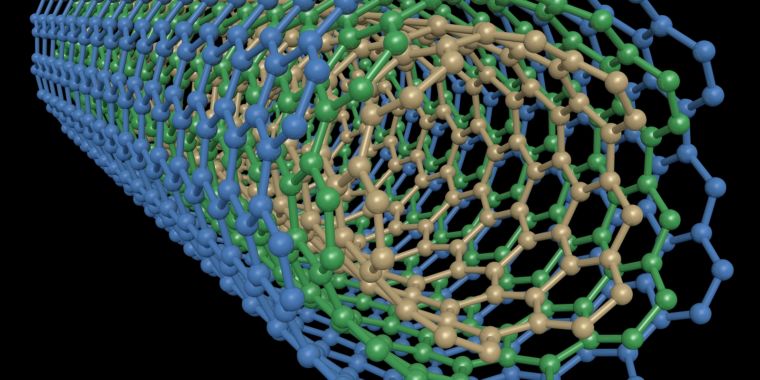
A carbon nanotube is tough—by some measures, more than 30 times more robust than Kevlar. As they’re only a few atoms thick, however, that toughness isn’t especially useful. Attempts have been made to bundle them together, but nothing has worked out especially well; the individual nanotubes are typically short, and it’s difficult to get them to all line up in the same direction.

As a result, these attempts have resulted in bundles that are filled with structural defects, often perform worse than Kevlar, and are only a few micrometers long. Now, a group at Beijing’s Tsinghua University seems to have found a way around many of these problems. It was able to synthesize nanotubes that are centimeters long and bundle them together to make a fiber that’s nearly as strong as an individual nanotube.

It’s not quite time to start booking rides on a space elevator, but this work at least hints that nanotubes might eventually break out of the realm of the microscopic. While the authors note that this work could find a home in ‘sports equipment, ballistic armour, aeronautics, astronautics and even space elevators,’ we’re still a long way from any of that. Ideally, rather than synthesizing the nanotubes in centimeter-long chunks, we’d like to have some sort of continual production process.

Still, the work is important in that it hints that there is a world beyond micrometer-scale nanotube fragments.

Source: arstechnica.com

Share :
comments powered by Disqus

Related Posts

A Chemist Shines Light on a Surprising Prime Number Pattern

About a year ago, the theoretical chemist Salvatore Torquato met with the number theorist Matthew de Courcy-Ireland to explain that he had done something highly unorthodox with prime numbers, those positive integers that are divisible only by 1 and themselves. Torquato told de Courcy-Ireland, a final-year graduate student at Princeton who had been recommended by another mathematician, that a year before, on a hunch, he had performed diffraction on sequences of prime numbers. Hoping to highlight the elusive order in the distribution of the primes, he and his student Ge Zhang had modeled them as a one-dimensional sequence of particles — essentially, little spheres that can scatter light.

Read More
The spectacular power of Big Lens

The spectacular power of Big Lens

If you have been wearing glasses for years, like me, it can be surprising to discover that you perceive the world thanks to a few giant companies that you have never heard of. Worrying about the fraying edge of motorway lights at night, or words that slide on the page, and occasionally spending a fortune at the opticians is, for many of us, enough to think about. And spectacles are unusual things.

Read More
How long can a neutron survive outside an atom?

How long can a neutron survive outside an atom?

Neutrons are probably best known for being a chargeless component of the nucleus of all atoms other than hydrogen. In that context, they can be extremely stable—you probably noted the fact that your body wasn’t decaying around you. But pull neutrons out of that context, and they become very unhappy.

Read More