Crossbar Pushes Resistive RAM into Embedded AI
Table of Contents
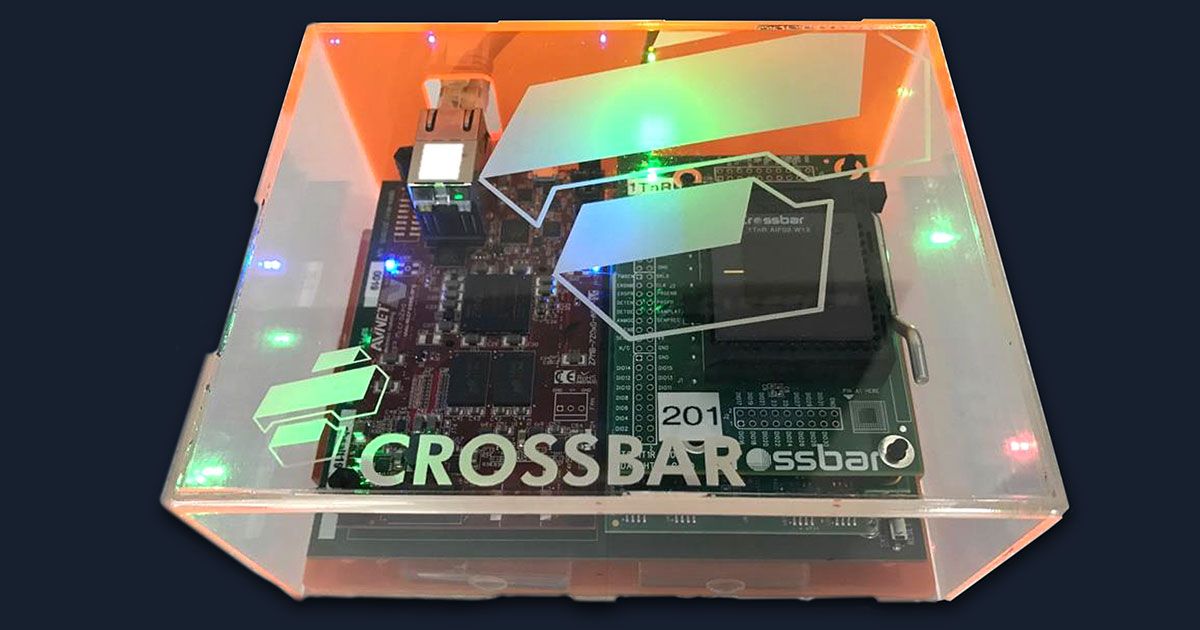
Resistive RAM technology developer Crossbar says it has inked a deal with aerospace chip maker Microsemi allowing the latter to embed Crossbar’s nonvolatile memory on future chips. The move follows selection of Crossbar’s technology by a leading foundry for advanced manufacturing nodes. Crossbar is counting on resistive RAM (ReRAM) to enable artificial intelligence systems whose neural networks are housed within the device rather than in the cloud.
ReRAM is a variant of the memristor, a nonvolatile memory device whose resistance can be set or reset by a pulse of voltage. The variant Crossbar qualified for advanced manufacturing is called a filament device. It’s built within the layers above a chip’s silicon, where the IC’s interconnects go, and it’s made up of three layers: from top to bottom—silver, amorphous silicon, and tungsten.
Voltage across the amorphous silicon causes a filament of silver atoms to cross the gap to the tungsten, making the memory cell conductive. Reversing the voltage pushes the silver back into place, cutting off conduction.
Source: ieee.org