A Deep Dive into Monte Carlo Tree Search

A Deep Dive into Monte Carlo Tree Search

  • May 21, 2018
Table of Contents

A Deep Dive into Monte Carlo Tree Search

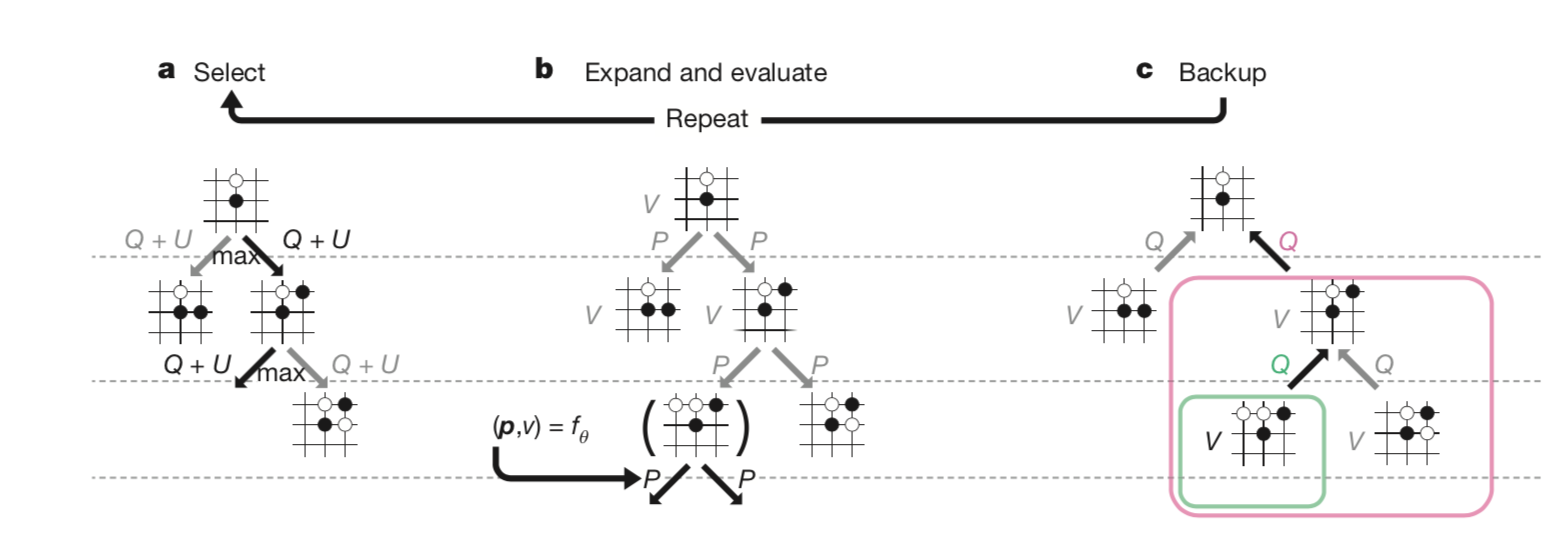
The very first Go AIs used multiple modules to handle each aspect of playing Go – life and death, capturing races, opening theory, endgame theory, and so on. The idea was that by having experts program each module using heuristics, the AI would become an expert in all areas of the game. All that came to a grinding halt with the introduction of Monte Carlo Tree Search (MCTS) around 2008.

MCTS is a tree search algorithm that dumped the idea of modules in favor of a generic tree search algorithm that operated in all stages of the game. MCTS AIs still used hand-crafted heuristics to make the tree search more efficient and accurate, but they far outperformed non-MCTS AIs. Go AIs then continued to improve through a mix of algorithmic improvements and better heuristics.

In 2016, AlphaGo leapfrogged the best MCTS AIs by replacing some heuristics with deep learning models, and AlphaGoZero in 2018 completely replaced all heuristics with learned models.

Source: moderndescartes.com

Tags :
Share :
comments powered by Disqus

Related Posts

AI and Compute

AI and Compute

We’re releasing an analysis showing that since 2012, the amount of compute used in the largest AI training runs has been increasing exponentially with a 3.5 month-doubling time (by comparison, Moore’s Law had an 18-month doubling period). Since 2012, this metric has grown by more than 300,000x (an 18-month doubling period would yield only a 12x increase). Improvements in compute have been a key component of AI progress, so as long as this trend continues, it’s worth preparing for the implications of systems far outside today’s capabilities.

Read More
The Nengo Neural Simulator

The Nengo Neural Simulator

Nengo is a graphical and scripting based Python package for simulating large-scale neural networks. Nengo can create sophisticated spiking or non-spiking neural simulations with sensible defaults in a few lines of code. Yet, Nengo is highly extensible and flexible.

Read More
Transfer Learning

Transfer Learning

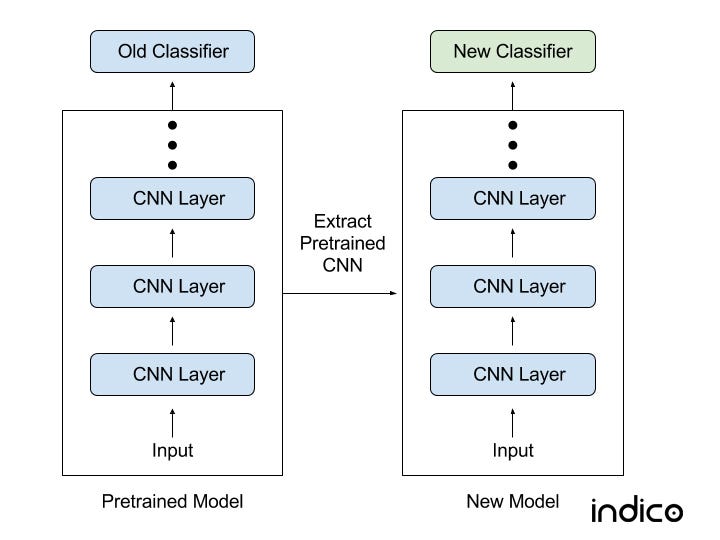
Transfer Learning is the reuse of a pre-trained model on a new problem. It is currently very popular in the field of Deep Learning because it enables you to train Deep Neural Networks with comparatively little data. This is very useful since most real-world problems typically do not have millions of labeled data points to train such complex models.

Read More