Microsoft Just Put a Data Center on the Bottom of the Ocean

Microsoft Just Put a Data Center on the Bottom of the Ocean

  • June 6, 2018
Table of Contents

Microsoft Just Put a Data Center on the Bottom of the Ocean

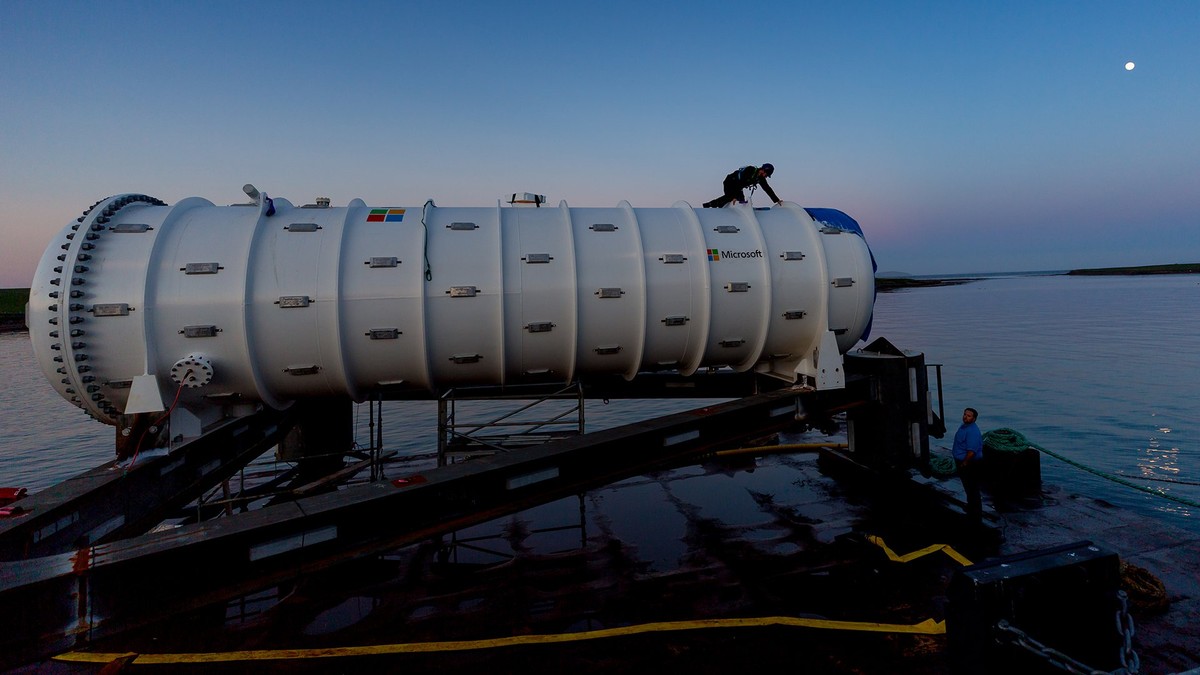
Microsoft just sent its first self-sufficient, waterproof data center to the bottom of the ocean floor near the Orkney Islands in Scotland, the company announced on Tuesday. About the size of a shipping container, the tubular data center holds 12 racks loaded with 864 servers and is attached to a large triangular weight that anchors it to the seabed over 100 feet beneath the ocean surface. The deployment of the data center represents the culmination of a nearly four year research effort code-named Project Natick, which aimed to develop rapidly deployable data centers that can support cloud computing services near major cities.

In addition to cutting down the amount of time needed to create a data center on land from about 2 years to around 90 days, the submarine data center has the added benefit of natural cooling from the ocean, eliminating one of the biggest costs of running a data center on land. The bottom of the ocean is also isolated from many disasters that could affect land based data centers, such as war or hurricanes, although Microsoft did not mention how difficult it would be to make repairs to the servers inside the container should they malfunction. The move is part of a larger push at Microsoft to become a leader in cloud computing, which is at the heart of most consumer-facing web applications you use on a day to day basis.

Considering that over half of the world’s population lives within 120 miles of the coast, submarine data centers can ensure that major cities are always close to the physical servers that comprise the cloud.

Source: vice.com
Share :
comments powered by Disqus

Related Posts

Reconciling GraphQL and Thrift at Airbnb

Reconciling GraphQL and Thrift at Airbnb

For several years, we had a few eager advocates for GraphQL at Airbnb, but the project never quite made it through the gates largely due to the perception that “GraphQL the Religion”—a worldview where all data is a graph all the way down—would be incompatible with our particular services-oriented architecture (SOA) strategy, which defines service-to-service communication using Thrift Interface Definition Language (IDL) and delivers data to clients via dedicated Presentation Services. We recently reframed a case for “GraphQL the API Layer.” Embracing how GraphQL could complement rather than compete with our Presentation Services, it found much more traction.

Read More
Open-sourcing gVisor, a sandboxed container runtime

Open-sourcing gVisor, a sandboxed container runtime

Containers have revolutionized how we develop, package, and deploy applications. However, the system surface exposed to containers is broad enough that many security experts don’t recommend them for running untrusted or potentially malicious applications. A growing desire to run more heterogenous and less trusted workloads has created a new interest in sandboxed containers—containers that help provide a secure isolation boundary between the host OS and the application running inside the container.

Read More
Showdown: MySQL 8 vs. PostgreSQL 10

Showdown: MySQL 8 vs. PostgreSQL 10

Now that MySQL 8 and PostgreSQL 10 are out, it’s a good time to revisit how the two major open source relational databases compete against each other. Before these versions, the general perception has been that while Postgres is superior in feature sets and its pedigree, MySQL is more battle tested at scale with massive concurrent reads/writes. But with the latest releases, the gap between the two has gotten significantly narrowed.

Read More