Brian Kernighan Remembers the Origins of ‘grep’

Brian Kernighan Remembers the Origins of ‘grep’

  • August 7, 2018
Table of Contents

Brian Kernighan Remembers the Origins of ‘grep’

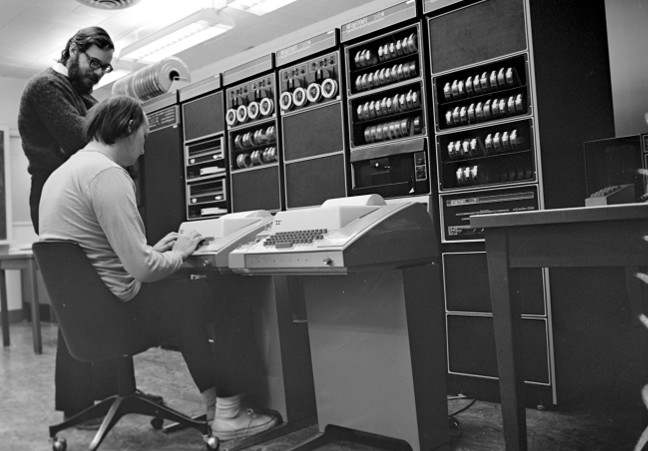
This month saw the release of a fascinating oral history, in which 76-year-old Brian Kernighan remembers the origins of the Unix command grep. Kernighan is already a legend in the world of Unix— recognized as the man who coined the term Unix back in 1970. His last initial also became the “k” in awk — and the “K” when people cite the iconic 1978 “K&R book” about C programming.

The original Unix Programmer’s Manual calls Kernighan an “expositor par excellence,” and since 2000 he’s been a computer science professor at Princeton University — after 30 years at the historic Computing Science Research Center at Bell Laboratories. AT&T as a whole had “well over” a million employees, Kernighan remembers, making them America’s single largest employer outside of government. Their dominant position as the phone company for most Americans gave them a very stable revenue stream, and research represented only a small fraction of the company.

“In some sense, it didn’t matter as long as this collection of people produced things that were useful,” he remembered. He didn’t meet Ken Thompson, the creator of Unix, until 1967, but eventually, he and Dennis Ritchie were all in the same organization as Kernighan. And this brings us to the moment when Thompson invented grep.

Source: thenewstack.io
Share :
comments powered by Disqus

Related Posts

Engineered Band Gap Pushes Graphene Closer to Displacing Silicon

Engineered Band Gap Pushes Graphene Closer to Displacing Silicon

A new method for engineering a band gap into graphene maintains its attractive electronic properties Graphene might bethe best conductor of electrons we know. However, as a pure conductor it can’t stop the flow of electrons like a semiconductor such as siliconcan. Silicon’s ability to create an on/off state for the flow of electrons makes it possible to create the “0” and “1” of binary digital logic for computing.

Read More
Containers, Security and Echo chambers

Containers, Security and Echo chambers

There seems to be some confusion around sandboxing containers as of late, mostly because of the recent launch of gvisor. Before I get into the body of this post I would like to make one thing clear. I have no problem with gvisor itself.

Read More
Ancient Rome’s Collapse Is Written into Arctic Ice

Ancient Rome’s Collapse Is Written into Arctic Ice

On March 15, some time ago, several dozen famous politicians—sturdy men, duly elected senators who claimed to love their republic—attacked their chief executive while he walked into the Senate. They stabbed Gaius Julius Caesar 23 times, as he fell to the floor, defenseless, and bled to death, setting off a chain of wars that formally ended the Roman Republic and initiated the Roman Empire. Some 2,062 years have passed since that day, but we haven’t stopped arguing about it.

Read More