Real Time Facial Expression Recognition
Table of Contents
Computer animated agents and robots bring new dimension in human computer interaction which makes it vital as how computers can affect our social life in day-to-day activities. Face to face communication is a real-time process operating at a time scale in the order of milliseconds. The level of uncertainty at this time scale is considerable, making it necessary for humans and machines to rely on sensory rich perceptual primitives rather than slow symbolic inference processes.
In this project we are presenting the real time facial expression recognition of seven most basic human expressions: ANGER, DISGUST, FEAR, HAPPY, NEUTRAL, SAD, SURPRISE. This model can be used for prediction of expressions of both still images and real time video. However, in both the cases we have to provide image to the model.
In case of real time video the image should be taken at any frame in time and feed it to the model for prediction of expression. The system automatically detects the face using HAAR cascade then its crops it and resize the image to a specific size and give it to the model for prediction. The model will generate seven probability values corresponding to seven expressions.
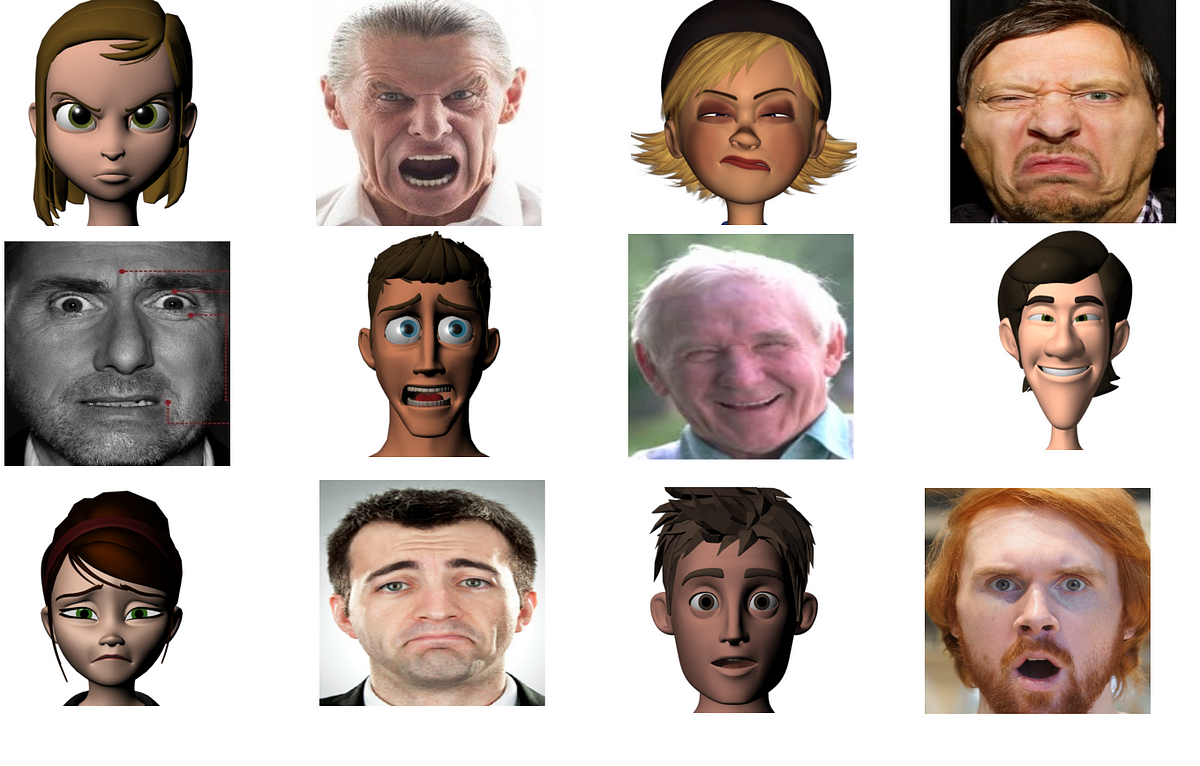
The highest probability value to the corresponding expression will be the predicted expression for that image. However, our goal here is to predict the human expressions, but we have trained our model on both human and animated images. Since, we had only approx 1500 human images which are very less to make a good model, so we took approximately 9000 animated images and leverage those animated images for training the model and ultimately do the prediction of expressions on human images.
Source: medium.com