Predictive Scaling for EC2, Powered by Machine Learning

Predictive Scaling for EC2, Powered by Machine Learning

  • November 21, 2018
Table of Contents

Predictive Scaling for EC2, Powered by Machine Learning

When I look back on the history of AWS and think about the launches that truly signify the fundamentally dynamic, on-demand nature of the cloud, two stand out in my memory: the launch of Amazon EC2 in 2006 and the concurrent launch of CloudWatch Metrics, Auto Scaling, and Elastic Load Balancing in 2009. The first launch provided access to compute power; the second made it possible to use that access to rapidly respond to changes in demand. We have added a multitude of features to all of these services since then, but as far as I am concerned they are still central and fundamental!

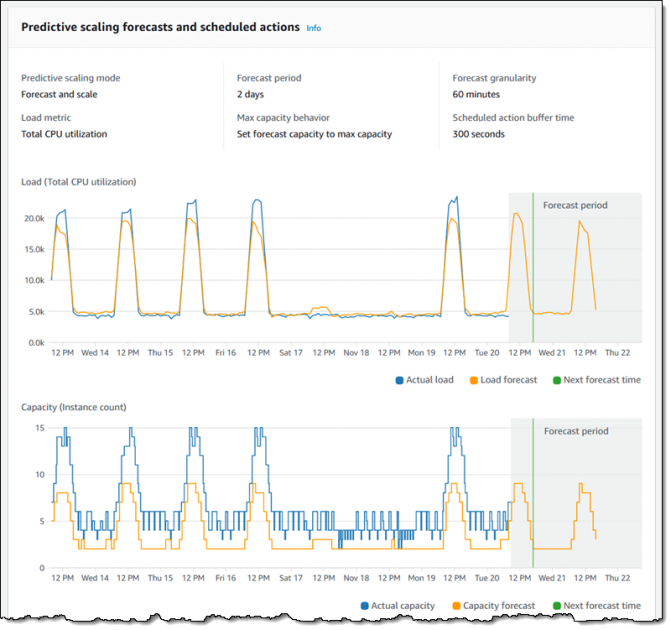
New Predictive Scaling Today we are making Auto Scaling even more powerful with the addition of predictive scaling. Using data collected from your actual EC2 usage and further informed by billions of data points drawn from our own observations, we use well-trained Machine Learning models to predict your expected traffic (and EC2 usage) including daily and weekly patterns. The model needs at least one day’s of historical data to start making predictions; it is re-evaluated every 24 hours to create a forecast for the next 48 hours.

Source: amazon.com

Tags :
Share :
comments powered by Disqus

Related Posts

Decision Tree in Machine Learning

Decision Tree in Machine Learning

A decision tree is a flowchart-like structure in which each internal node represents a test on a feature (e.g. whether a coin flip comes up heads or tails), each leaf node represents a class label (decision taken after computing all features) and branches represent conjunctions of features that lead to those class labels. The paths from root to leaf represent classification rules. Below diagram illustrate the basic flow of decision tree for decision making with labels (Rain(Yes), No Rain(No)).

Read More
Learning Concepts with Energy Functions

Learning Concepts with Energy Functions

We’ve developed an energy-based model that can quickly learn to identify and generate instances of concepts, such as near, above, between, closest, and furthest, expressed as sets of 2d points. Our model learns these concepts after only five demonstrations.

Read More
Five Lessons From the First Three Years of Michelangelo

Five Lessons From the First Three Years of Michelangelo

Uber has been one of the most active contributors to open source machine learning technologies in the last few years. While companies like Google or Facebook have focused their contributions in new deep learning stacks like TensorFlow, Caffe2 or PyTorch, the Uber engineering team has really focused on tools and best practices for building machine learning at scale in the real world. Technologies such as Michelangelo, Horovod, PyML, Pyro are some of examples of Uber’s contributions to the machine learning ecosystem.

Read More