FastMRI open source tools from Facebook and NYU

FastMRI open source tools from Facebook and NYU

  • November 27, 2018
Table of Contents

FastMRI open source tools from Facebook and NYU

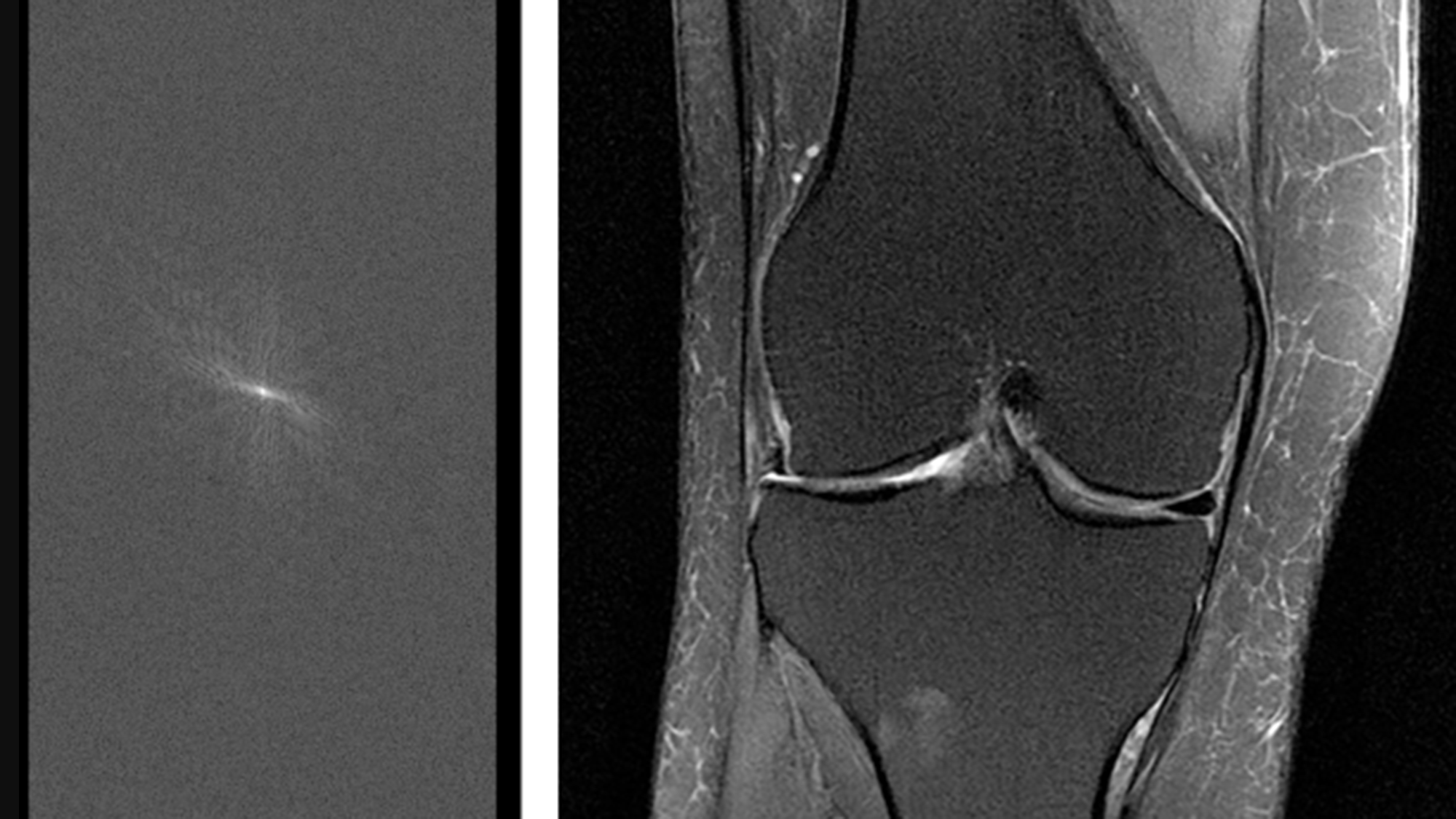
Facebook AI Research (FAIR) and NYU School of Medicine’s Center for Advanced Imaging Innovation and Research (CAI²R) are sharing new open source tools and data as part of fastMRI, a joint research project to spur development of AI systems to speed MRI scans by up to 10x. Today’s releases include new AI models and baselines for this task(as described in our paper here). It also includes the first large-scale MRI data set of its kind, which can serve as a benchmark for future research.

By sharing a standardized set of AI tools and MRI data, as well as hosting a leaderboard where research teams can compare their results, we aim to help improve diagnostic imaging technology, and eventually increase patients’ access to a powerful and sometimes life-saving technology. With new AI techniques, we hope to generate scans that require much less measurement data to produce the image detail necessary for accurate detection of abnormalities. Sharing this suite of resources reflects the fastMRI mission, which is to engage the larger community of AI and medical imaging researchers rather than to develop proprietary methods for accelerating MR imaging.

Improved accuracy with increased training data: This chart shows the impact of four sizes of training sets on the performance of our baseline ML models, which used a U-net neural network architecture. The more MRI cases the system was trained on, the lower its loss was, indicating that its image predictions were more likely to be accurate.

Source: fb.com
Tags :
Share :
comments powered by Disqus

Related Posts

Radiology and Deep Learning

Radiology and Deep Learning

Radiology and DeepLearningDetecting pneumonia opacities from chest X-Ray images using deep learning. One day back in August, I was catching up with my best friend from high school who is now a radiology resident. One thing led to another, and we started talking about our interests in artificial intelligence and machine learning and its possible applications in radiology.

Read More
Real Time Facial Expression Recognition

Real Time Facial Expression Recognition

Computer animated agents and robots bring new dimension in human computer interaction which makes it vital as how computers can affect our social life in day-to-day activities. Face to face communication is a real-time process operating at a time scale in the order of milliseconds. The level of uncertainty at this time scale is considerable, making it necessary for humans and machines to rely on sensory rich perceptual primitives rather than slow symbolic inference processes.

Read More
Decision Tree in Machine Learning

Decision Tree in Machine Learning

A decision tree is a flowchart-like structure in which each internal node represents a test on a feature (e.g. whether a coin flip comes up heads or tails), each leaf node represents a class label (decision taken after computing all features) and branches represent conjunctions of features that lead to those class labels. The paths from root to leaf represent classification rules. Below diagram illustrate the basic flow of decision tree for decision making with labels (Rain(Yes), No Rain(No)).

Read More