Montezuma’s Revenge Solved by Go-Explore, a New Algorithm for Hard-exploration Problems

Montezuma’s Revenge Solved by Go-Explore, a New Algorithm for Hard-exploration Problems

  • November 27, 2018
Table of Contents

Montezuma’s Revenge Solved by Go-Explore, a New Algorithm for Hard-exploration Problems

In deep reinforcement learning (RL), solving the Atari games Montezuma’s Revenge and Pitfall has been a grand challenge. These games represent a broad class of challenging, real-world problems called “hard-exploration problems,” where an agent has to learn complex tasks with very infrequent or deceptive feedback. The state-of-the-art algorithm on Montezuma’s Revenge gets an average score of 11,347, a max score of 17,500, and solved the first level at one point in one of ten tries.

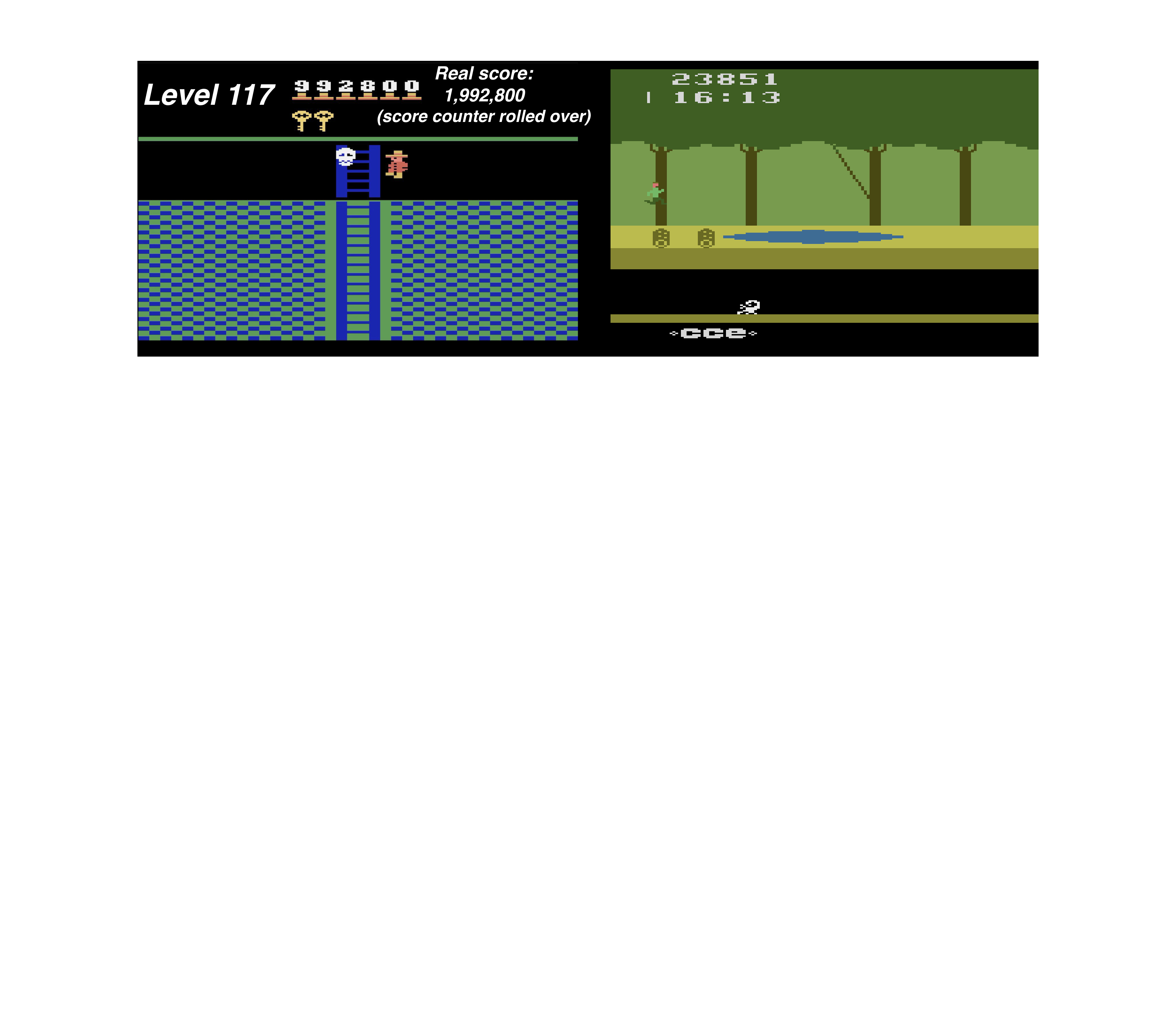
Surprisingly, despite considerable research effort, so far no algorithm has obtained a score greater than 0 on Pitfall. Today we introduce Go-Explore, a new family of algorithms capable of achieving scores over 2,000,000 on Montezuma’s Revenge and scoring over 400,000 on average! Go-Explore reliably solves the entire game, meaning all three unique levels, and then generalizes to the nearly-identical subsequent levels (which only differ in the timing of events and the score on the screen).

We have even seen it reach level 159!

Source: uber.com
Tags :
Share :
comments powered by Disqus

Related Posts

Predictive Scaling for EC2, Powered by Machine Learning

Predictive Scaling for EC2, Powered by Machine Learning

When I look back on the history of AWS and think about the launches that truly signify the fundamentally dynamic, on-demand nature of the cloud, two stand out in my memory: the launch of Amazon EC2 in 2006 and the concurrent launch of CloudWatch Metrics, Auto Scaling, and Elastic Load Balancing in 2009. The first launch provided access to compute power; the second made it possible to use that access to rapidly respond to changes in demand. We have added a multitude of features to all of these services since then, but as far as I am concerned they are still central and fundamental!

Read More
FastMRI open source tools from Facebook and NYU

FastMRI open source tools from Facebook and NYU

Facebook AI Research (FAIR) and NYU School of Medicine’s Center for Advanced Imaging Innovation and Research (CAI²R) are sharing new open source tools and data as part of fastMRI, a joint research project to spur development of AI systems to speed MRI scans by up to 10x. Today’s releases include new AI models and baselines for this task(as described in our paper here). It also includes the first large-scale MRI data set of its kind, which can serve as a benchmark for future research.

Read More