Observability at Scale: Building Uber’s Alerting Ecosystem

Observability at Scale: Building Uber’s Alerting Ecosystem

  • December 22, 2018
Table of Contents

Observability at Scale: Building Uber’s Alerting Ecosystem

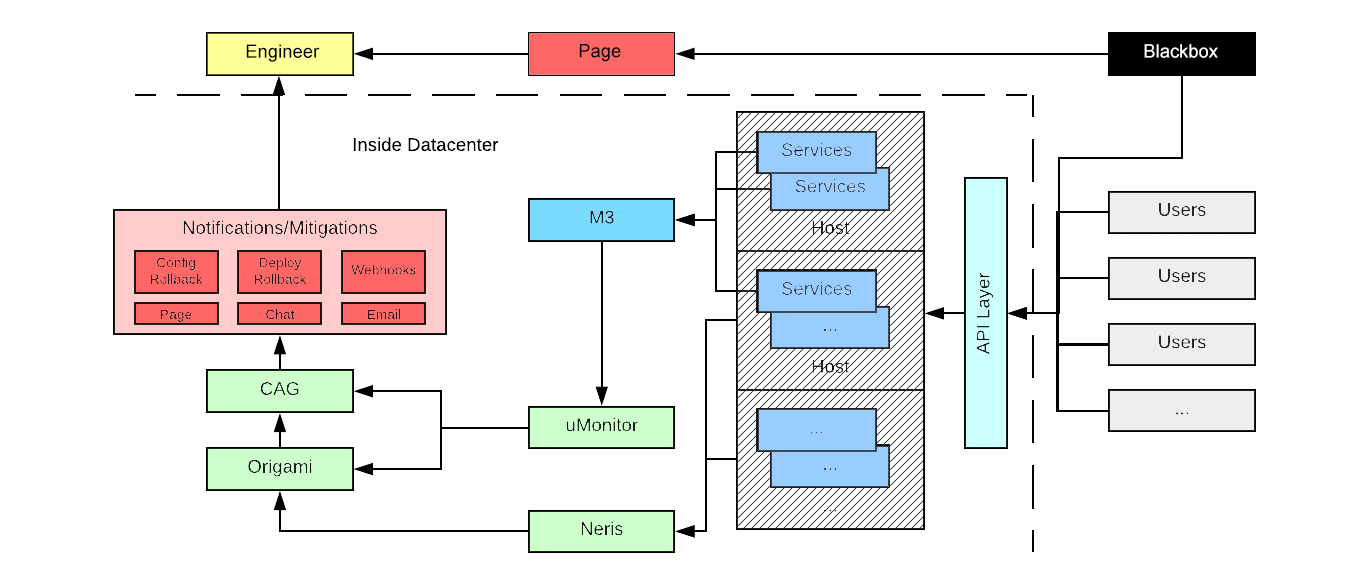
Uber’s software architectures consists of thousands of microservices that empower teams to iterate quickly and support our company’s global growth. These microservices support a variety of solutions, such as mobile applications, internal and infrastructure services, and products along with complex configurations that affect these products at city and sub-city levels. To maintain our growth and architecture, Uber’s Observability team built a robust, scalable metrics and alerting pipeline responsible for detecting, mitigating, and notifying engineers of issues with their services as soon as they occur.

Specifically, we built two in-data center alerting systems, called uMonitor and Neris, that flow into the same notification and alerting pipeline. uMonitor is our metrics-based alerting system that runs checks against our metrics database M3, while Neris primarily looks for alerts in host-level infrastructure.

Source: uber.com

Share :
comments powered by Disqus

Related Posts

Scaling Cash Payments in Uber Eats

Scaling Cash Payments in Uber Eats

This article is the fourth in a series covering how Uber’s mobile engineering team developed the newest version of our driver app, codenamed Carbon, a core component of our ridesharing business. Among other new features, the app lets our population of over three million driver-partners find fares, get directions, and track their earnings. We began designing the new app in conjunction with feedback from our driver-partners in 2017 and began rolling it out for production in September 2018.

Read More
Cape Technical Deep Dive

Cape Technical Deep Dive

In this post, we’ll take a deep dive into the design of the Cape framework. First, we’ll discuss Cape’s architecture. Then we’ll look at the core scheduling component of the system.

Read More
Implementing the Netflix Media Database

Implementing the Netflix Media Database

In the previous blog posts in this series, we introduced the Netflix Media DataBase (NMDB) and its salient “Media Document” data model. In this post we will provide details of the NMDB system architecture beginning with the system requirements—these will serve as the necessary motivation for the architectural choices we made. A fundamental requirement for any lasting data system is that it should scale along with the growth of the business applications it wishes to serve.

Read More