Kubernetes Failure Stories

Kubernetes Failure Stories

  • January 20, 2019
Table of Contents

Kubernetes Failure Stories

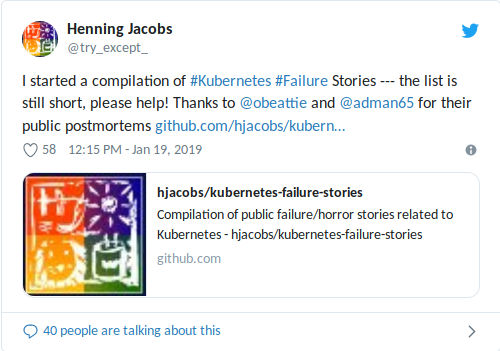
I started to compile a list of public failure/horror stories related to Kubernetes. It should make it easier for people tasked with operations to find outage reports to learn from. Since we started with Kubernetes at Zalando in 2016, we collected many internal postmortems.

Docker bugs (daemon unresponsive, process stuck in pipe wait, ..) were a major pain point in the beginning, but Docker itself has become more mature and did not bite us recently. The biggest chunk of problems can be attributed to the nature of distributed systems and ‘cascading failures’, e.g. a Kubernetes API server outage should not affect running workloads, but it did, or see our recent CoreDNS incident.

Source: srcco.de

Share :
comments powered by Disqus

Related Posts

The Biggest IT Failures of 2018

The Biggest IT Failures of 2018

This year provedonce againthat IT-related failures “are universally unprejudiced: they happen in every country; to large companies and small; in commercial, nonprofit, and governmental organizations; and without regard to status or reputation.” Below is a review that just scratches the surface of the sundry failures, glitches, and other IT hiccups that made the news in 2018. This year saw a slight reduction in the number of flight cancellations and delays due to computer-related problems as compared with the past three years, especially in the United States.

Read More
PostgreSQL across clouds and on-premises

PostgreSQL across clouds and on-premises

PostgreSQL is a very popular open source relational database. It’s been in active development for over 30 years and has achieved a very high level of reliability and performance, as well as a very robust feature set.

Read More
Observability at Scale: Building Uber’s Alerting Ecosystem

Observability at Scale: Building Uber’s Alerting Ecosystem

Uber’s software architectures consists of thousands of microservices that empower teams to iterate quickly and support our company’s global growth. These microservices support a variety of solutions, such as mobile applications, internal and infrastructure services, and products along with complex configurations that affect these products at city and sub-city levels. To maintain our growth and architecture, Uber’s Observability team built a robust, scalable metrics and alerting pipeline responsible for detecting, mitigating, and notifying engineers of issues with their services as soon as they occur.

Read More