Poseidon-Firmament Scheduler – Flow Network Graph Based Scheduler

Poseidon-Firmament Scheduler – Flow Network Graph Based Scheduler

  • February 8, 2019
Table of Contents

Poseidon-Firmament Scheduler – Flow Network Graph Based Scheduler

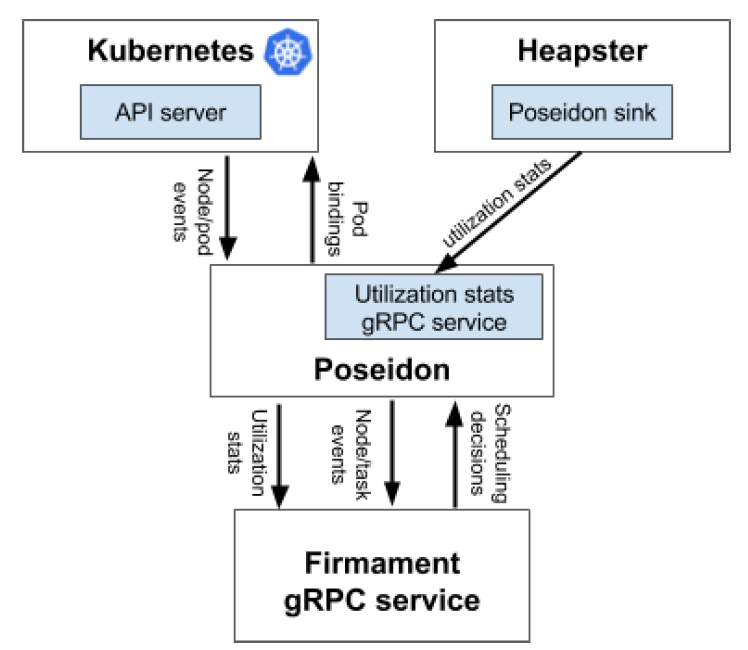
In this blog post, we briefly describe the novel Firmament flow network graph based scheduling approach (OSDI paper) in Kubernetes. We specifically describe the Firmament Scheduler and how it integrates with the Kubernetes cluster manager using Poseidon as the integration glue. We have seen extremely impressive scheduling throughput performance benchmarking numbers with this novel scheduling approach.

Originally, Firmament Scheduler was conceptualized, designed and implemented by University of Cambridge researchers, Malte Schwarzkopf & Ionel Gog. At a very high level, Poseidon-Firmament scheduler augments the current Kubernetes scheduling capabilities by incorporating novel flow network graph based scheduling capabilities alongside the default Kubernetes Scheduler. It models the scheduling problem as a constraint-based optimization over a flow network graph – by reducing scheduling to a min-cost max-flow optimization problem.

Due to the inherent rescheduling capabilities, the new scheduler enables a globally optimal scheduling environment that constantly keeps refining the workloads placements dynamically.

Source: kubernetes.io

Share :
comments powered by Disqus

Related Posts

Container Storage Interface (CSI) for Kubernetes GA

Container Storage Interface (CSI) for Kubernetes GA

The Kubernetes implementation of the Container Storage Interface (CSI) has been promoted to GA in the Kubernetes v1.13 release. Support for CSI was introduced as alpha in Kubernetes v1.9 release, and promoted to beta in the Kubernetes v1.10 release. The GA milestone indicates that Kubernetes users may depend on the feature and its API without fear of backwards incompatible changes in future causing regressions.

Read More
Sidestepping Dependency Ordering with AppSwitch

Sidestepping Dependency Ordering with AppSwitch

We are going through an interesting cycle of application decomposition and recomposition. While the microservice paradigm is driving monolithic applications to be broken into separate individual services, the service mesh approach is helping them to be connected back together into well-structured applications. As such, microservices are logically separate but not independent.

Read More
The State of Kubernetes Configuration Management

The State of Kubernetes Configuration Management

Configuration management is a hard, unsolved problem. We share some unique insights about the strengths and weaknesses of several popular K8s config management tools. Of all the problems we have confronted, the ones over which the most brainpower, ink, and code have been spilled are related to managing configurations.

Read More