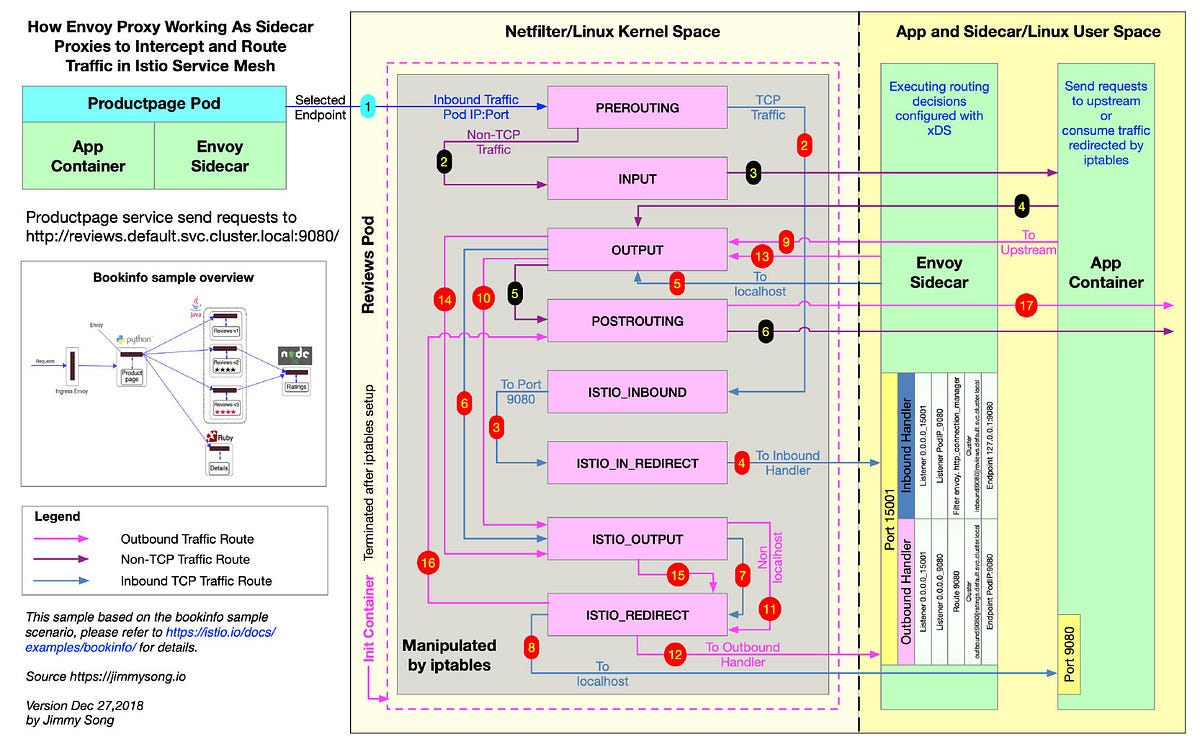
How to automatically generate a new metric and a new log stream in Service Mesh

How to automatically generate a new metric and a new log stream in Service Mesh

  • March 2, 2019
Table of Contents

How to automatically generate a new metric and a new log stream in Service Mesh

One of the advantage of deploying a microservice-based application in an Istio service mesh is to allow one to externally control service monitoring, tracing, request (version) routing, resiliency testing, security and policy enforcement, etc., in a consistent way across those services, for the application as a whole. In this blog we will focus on the in-depth telemetry side of the house and see how can we configure mixer to collect a uniform set of metrics across all services. At the end of this blog our goal will be to have a new metric and a new log stream enabled for calls to services within our mesh.

We are going to use the Bookinfo application as an example.

Source: openshift.com
Share :
comments powered by Disqus

Related Posts

Istio Multicluster

Istio Multicluster

Istio Multicluster is a feature of Istio–the basis of Red Hat OpenShift Service Mesh–that allows for the extension of the service mesh across multiple Kubernetes or Red Hat OpenShift clusters. The primary goal of this feature is to enable control of services deployed across multiple clusters with a single control plane. The main requirement for Istio multicluster to work is that the pods in the mesh and the Istio control plane can talk to each other.

Read More
A Crash Course For Running Istio

A Crash Course For Running Istio

At Namely we’ve been running with Istio for a year now. Yes, that’s pretty much when it first came out. We had a major performance regression with a Kubernetes cluster, we wanted distributed tracing, and used Istio to bootstrap Jaeger to investigate.

Read More