How to automatically generate a new metric and a new log stream in Service Mesh

How to automatically generate a new metric and a new log stream in Service Mesh

  • March 2, 2019
Table of Contents

How to automatically generate a new metric and a new log stream in Service Mesh

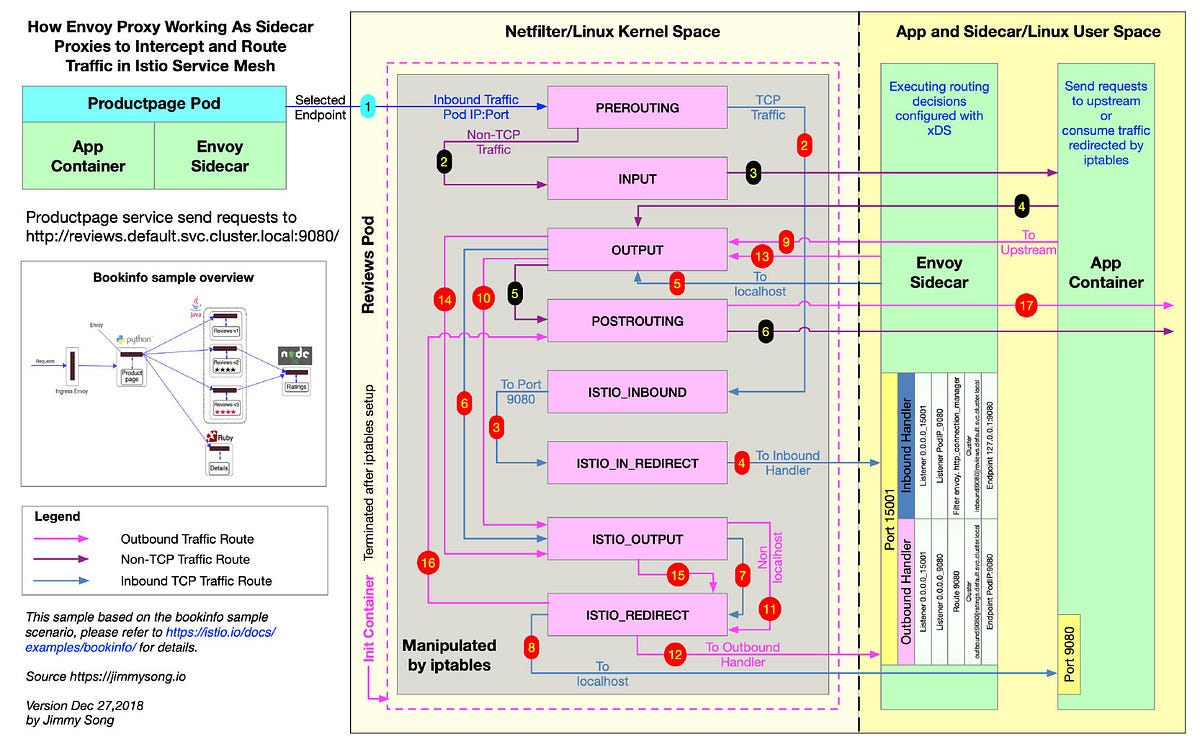
One of the advantage of deploying a microservice-based application in an Istio service mesh is to allow one to externally control service monitoring, tracing, request (version) routing, resiliency testing, security and policy enforcement, etc., in a consistent way across those services, for the application as a whole. In this blog we will focus on the in-depth telemetry side of the house and see how can we configure mixer to collect a uniform set of metrics across all services. At the end of this blog our goal will be to have a new metric and a new log stream enabled for calls to services within our mesh.

We are going to use the Bookinfo application as an example.

Source: openshift.com
Share :
comments powered by Disqus

Related Posts

Combining Federation V2 and Istio Multicluster

Combining Federation V2 and Istio Multicluster

In a previous post, we saw how to leverage Istio Multicluster to deploy an application (bookinfo) on multiple Red Hat OpenShift clusters and apply mesh policies on all of the deployed services. We also saw that the deployment process was relatively complex. In this post we are going to see how Federation V2 can help simplify the process of deploying an application to multiple clusters.

Read More
Sidestepping Dependency Ordering with AppSwitch

Sidestepping Dependency Ordering with AppSwitch

We are going through an interesting cycle of application decomposition and recomposition. While the microservice paradigm is driving monolithic applications to be broken into separate individual services, the service mesh approach is helping them to be connected back together into well-structured applications. As such, microservices are logically separate but not independent.

Read More
Jaeger integration in Kiali

Jaeger integration in Kiali

Kiali has the ability to show traces obtained from Istio. Jaeger collects traces for monitoring and troubleshooting microservices-based distributed systems, and both Istio and Kiali use the data that Jaeger provides. Originally this was done via a separate tab in the UI.

Read More