Packets-per-second limits in EC2

Packets-per-second limits in EC2

  • April 28, 2019
Table of Contents

Packets-per-second limits in EC2

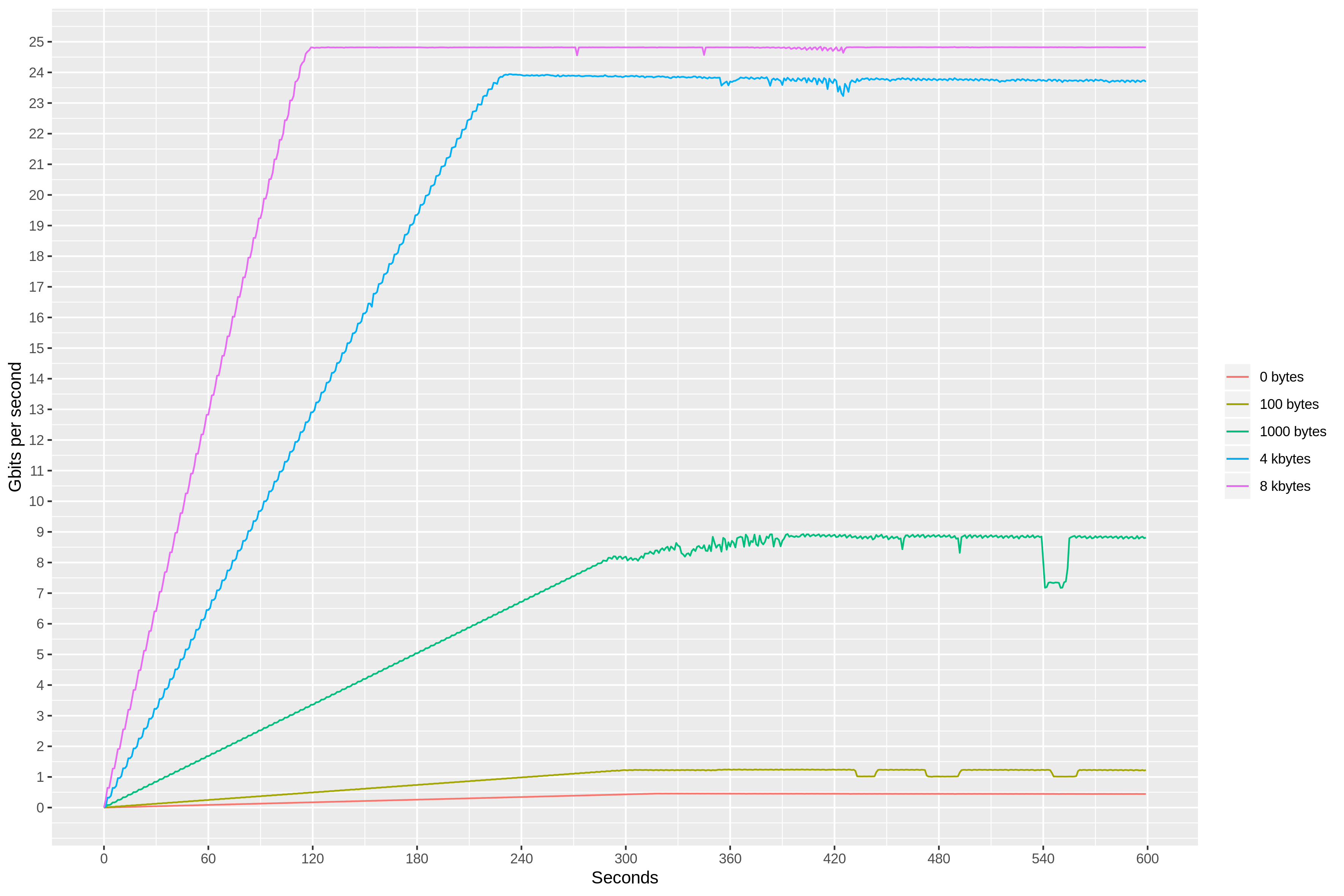
While evaluating the performance of a server application, we eventually (and hopefully) run up against the most fundamental constraining factor: the network. Cloud providers tend to offer somewhat handwavy guidance on networking constraints, especially when compared to the exhaustive literature explaining the quotas for RAM, CPU, and I/O. While working on an unrelated stress test in EC2, we were surprised by some results that led us down the path of investigating EC2 network capacity claims, resulting in this writeup. EC2 documentation describes network performance in terms of maximum available bandwidth.

Instances using Enhanced Networking can have bandwidth up to 25 Gbit /s. This is great news for a video streaming service, but what does this maximum bandwidth mean for a transactional application, such as an HTTP server?

Do we add up all payload and protocol overhead to see if fits the bandwidth budget? To answer this question, we have to look at how lower level protocolsâlike TCP and IPâhandle HTTP transactions.

Source: stressgrid.com

Share :
comments powered by Disqus

Related Posts

When AWS Autoscale Doesn’t

When AWS Autoscale Doesn’t

The premise behind autoscaling in AWS is simple: you can maximize your ability to handle load spikes and minimize costs if you automatically scale your application out based on metrics like CPU or memory utilization. If you need 100 Docker containers to support your load during the day but only 10 when load is lower at night, running 100 containers at all times means that you’re using 900% more capacity than you need every night. With a constant container count, you’re either spending more money than you need to most of the time or your service will likely fall over during a load spike.

Read More
Crossplane lowers the barrier to a multi-cloud future

Crossplane lowers the barrier to a multi-cloud future

Cloud computing has become the dominant IT paradigm and multi-cloud looks poised to be the primary approach, with 81 percent of enterprises already adopting a multi-cloud strategy. A multi-cloud strategy prevents vendor lock-in, which is increasingly important as three major providers (AWS, GCP, and Azure) dominate the market. Despite the many benefits of a multi-cloud strategy, deploying across multiple clouds is still incredibly complex.

Read More