Building Lyft’s Marketing Automation Platform

Building Lyft’s Marketing Automation Platform

  • June 28, 2019
Table of Contents

Building Lyft’s Marketing Automation Platform

We take pride in our mission to improve people’s lives with the world’s best transportation. More than 50 million carbon neutral Lyft rides happen every month across the US and Canada—and we’ve barely scratched the surface in the potential for rideshare. Part of our growth is improvements in our acquisition process—like launching region-specific ad campaigns that increase awareness, and consideration of our multi-modal offerings.

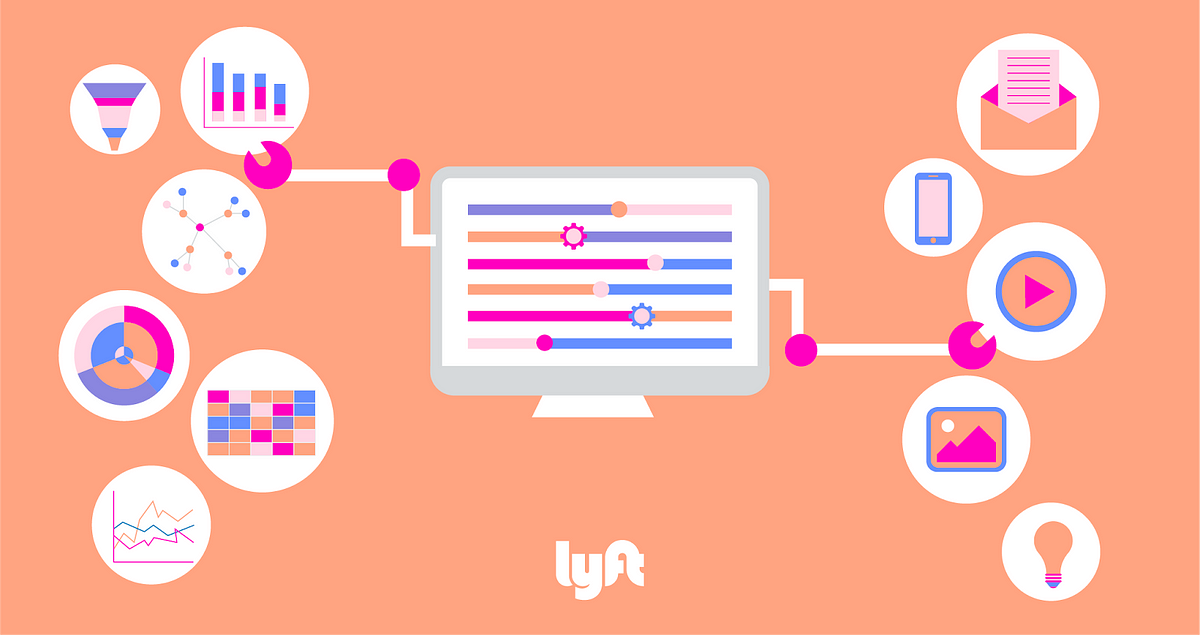
Coordinating these campaigns to acquire new users at scale has become time-consuming, leading us to take on the challenge of automation. Acquisition is typically led by a data-driven cross-functional team that focuses on scale, measurability, and predictability. You may have seen Lyft ads like these: Acquisition operates at the top and largest part of the onboarding funnel, through the various channels listed on the left.

No two channels are created equal: we work with different partners, technologies, and strategies to make sure that Lyft is the top choice for consumers. Other teams at Lyft focus on different parts of the user journey to provide a world-class experience. A high-level view is shown below.

Acquiring users at scale means making thousands of decisions each day, for each region where Lyft operates: choosing bids, budgets, creatives, incentives, and audiences; running tests; and more. Just keeping up with these repeated tasks occupies a great deal of marketers’ mindshare and can lead to suboptimal decisions. It’s expensive to the business and does not scale.

Source: lyft.com

Tags :
Share :
comments powered by Disqus

Related Posts

eBay Moves Away From OpenStack, Embraces Kubernetes and Docker

eBay Moves Away From OpenStack, Embraces Kubernetes and Docker

As part of an initiative to completely revamp its data center infrastructure, eBay is “re-platforming, using Kubernetes and Docker and moving away from OpenStack,” according to a message to SDxCentral from Mazen Rawashdeh, VP of platform engineering at eBay. In May 2017 at the OpenStack Summit in Boston, an eBay executive said that 95 percent of all eBay traffic ran on its OpenStack cloud, which at the time managed 167,000virtual machines(VMs) and 4,000 applications. But since then, eBay has pivoted away from OpenStack as part of a major three-year infrastructure initiative.

Read More
Scaling Cash Payments in Uber Eats

Scaling Cash Payments in Uber Eats

This article is the fourth in a series covering how Uber’s mobile engineering team developed the newest version of our driver app, codenamed Carbon, a core component of our ridesharing business. Among other new features, the app lets our population of over three million driver-partners find fares, get directions, and track their earnings. We began designing the new app in conjunction with feedback from our driver-partners in 2017 and began rolling it out for production in September 2018.

Read More
Uber’s Path of Destruction

Uber’s Path of Destruction

Since it began operations in 2010, Uber has grown to the point where it now collects over $45 billion in gross passenger revenue, and it has seized a major share of the urban car service market. But the widespread belief that it is a highly innovative and successful company has no basis in economic reality. An examination of Uber’s economics suggests that it has no hope of ever earning sustainable urban car service profits in competitive markets.

Read More