Facebook has found a place to park its $40bn+ cash reserves

Facebook has found a place to park its $40bn+ cash reserves

  • June 28, 2019
Table of Contents

Facebook has found a place to park its $40bn+ cash reserves

There is no concept of a block of transactions in the ledger history—Libra’s technical paper. But who cares whether it’s technically a blockchain or not, as long as it’s permissioned it might as well be a MySQL database that’s updated with a voting system written in PHP for all i care. Don’t get me wrong, I don’t hold a Bitcoin maximalist perspective, I’m quite value neutral with respect to the project, even a bit optimistic.

I’m personally most interested in getting to the economic substance of the project, the product implications and the effects on the wider crypto ecosystem. In this post I’m describing a novel perspective on Libra, which is somewhat different from what you’ll find in most mainstream media outlets. Expect maybe the Financial Times, most have either bought into the ‘crypto narrative’ or have made this another episode of FB privacy rants.

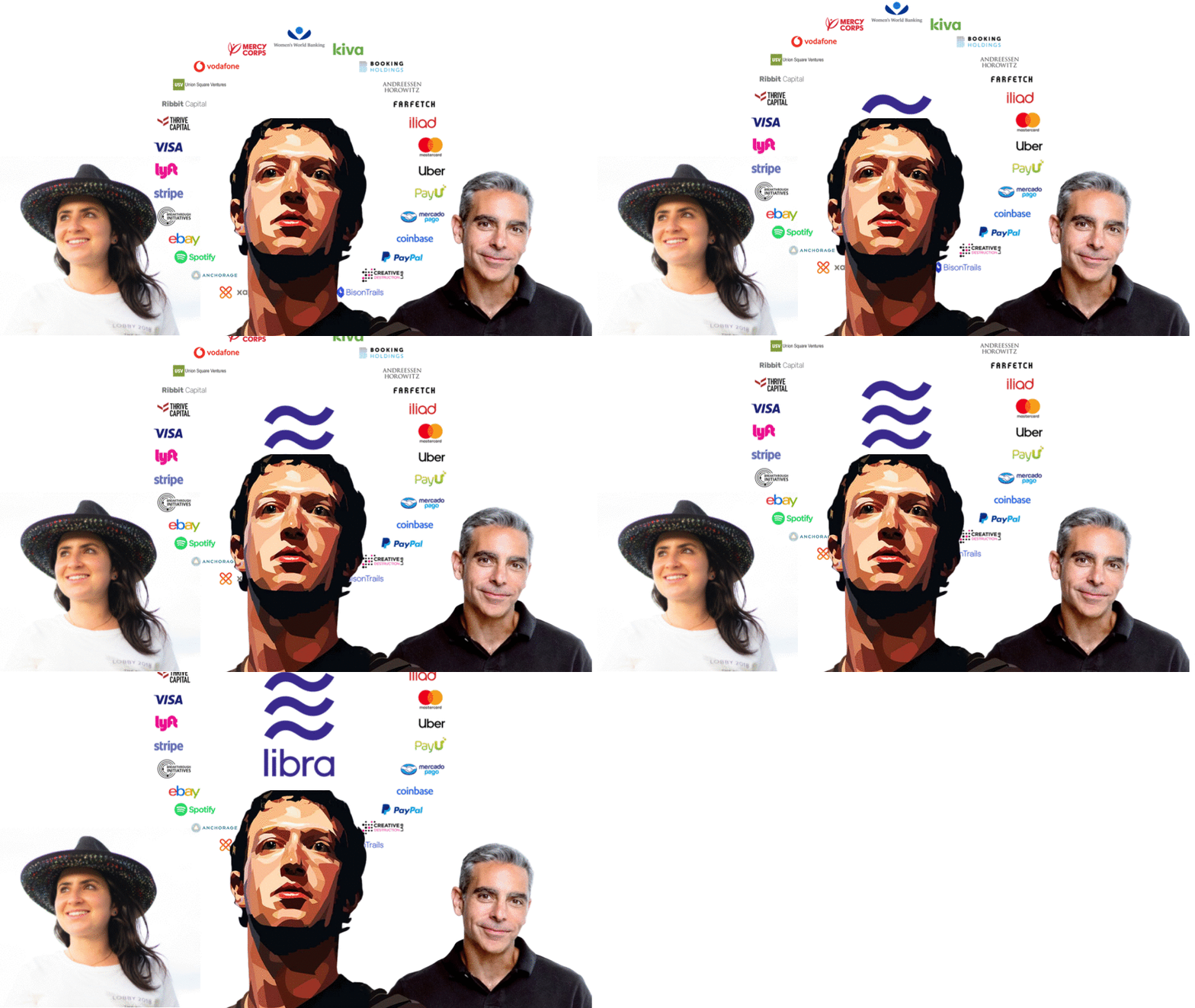
Meanwhile, no one has actually looked at why this is actually a genius idea from the side of Facebook’s balance sheet… So my ‘theory’ involves: An understanding of Libra as a massive money market fund that puts Facebook’s $40bn+ idle cash reserves to productive use and at the same time gives Facebook a huge inflow of interest-bearing liquidity to manage (notably, interest it doesn’t have to pass on to depositors!).The Libra challenges or forces us to revisit Joel Monégro’s ‘fat protocol theory’ in crypto that has come to dominate our thinking on where value is created in crypto (protocol vs. application level).

Source: hackernoon.com

Tags :
Share :
comments powered by Disqus

Related Posts

eBay Moves Away From OpenStack, Embraces Kubernetes and Docker

eBay Moves Away From OpenStack, Embraces Kubernetes and Docker

As part of an initiative to completely revamp its data center infrastructure, eBay is “re-platforming, using Kubernetes and Docker and moving away from OpenStack,” according to a message to SDxCentral from Mazen Rawashdeh, VP of platform engineering at eBay. In May 2017 at the OpenStack Summit in Boston, an eBay executive said that 95 percent of all eBay traffic ran on its OpenStack cloud, which at the time managed 167,000virtual machines(VMs) and 4,000 applications. But since then, eBay has pivoted away from OpenStack as part of a major three-year infrastructure initiative.

Read More
Multi-Cloud Is a Trap

Multi-Cloud Is a Trap

It comes up in a lot of conversations with clients. We want to be cloud-agnostic. We need to avoid vendor lock-in.

Read More
Scaling Cash Payments in Uber Eats

Scaling Cash Payments in Uber Eats

This article is the fourth in a series covering how Uber’s mobile engineering team developed the newest version of our driver app, codenamed Carbon, a core component of our ridesharing business. Among other new features, the app lets our population of over three million driver-partners find fares, get directions, and track their earnings. We began designing the new app in conjunction with feedback from our driver-partners in 2017 and began rolling it out for production in September 2018.

Read More