Visualizing Istio external traffic with Kiali

Visualizing Istio external traffic with Kiali

  • June 28, 2019
Table of Contents

Visualizing Istio external traffic with Kiali

Suppose that you have an application using several third party services to store files, send messages, write tweets, etc. It is useful to know how much traffic is going off your mesh to these services, for example, you might want to know how many requests are directed to twitter or how much data is being sent to Dropbox. Also knowing if these requests are successful or if they fail.

Istio provides a resource called Service Entry. It allows to plug additional services into your mesh so that other services can access these manually defined resources. These resources can be part of your mesh (e.g. VMs) or services external to the mesh (e.g. Twitter, Dropbox, etc).

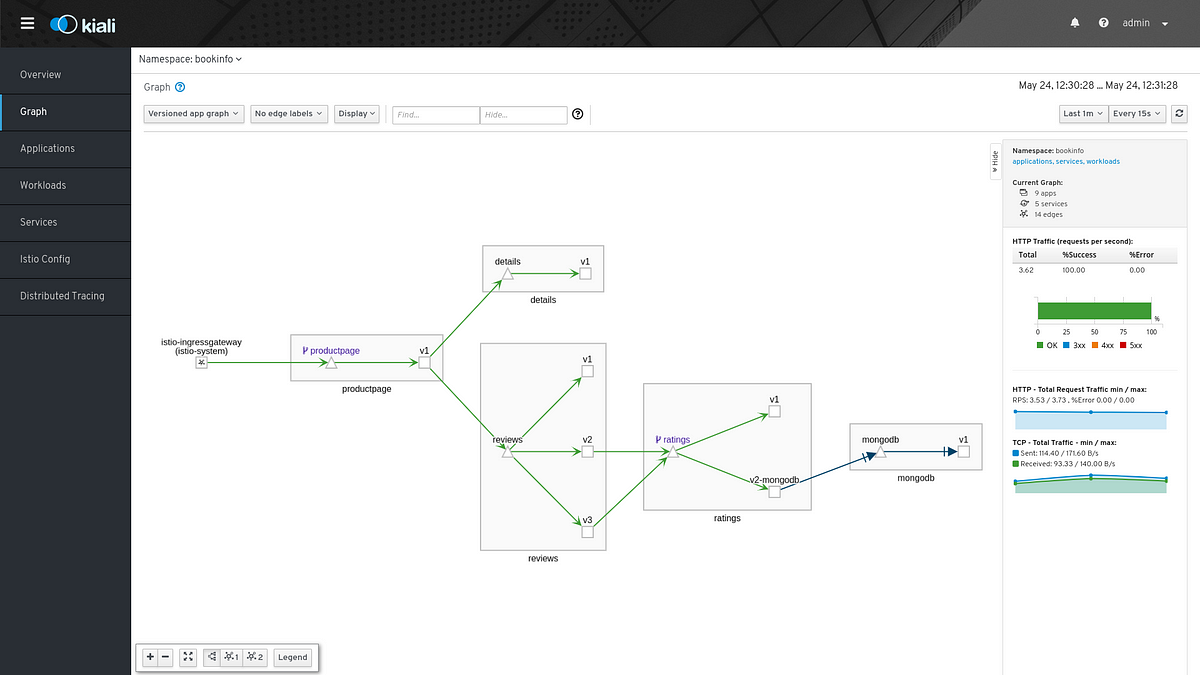
We are going to use Istio’s Bookinfo example to show you how to observe external services. You can install it by following the instructions found on Istio’s docs. Once you have it installed and you are able to drive traffic to productpage service, you can see what we call the “Versioned app graph” by going to Kiali.

Configuring external trafficUsing Bookinfo example, there is a service that could optionally request the book information using Google API, to enable it run the following command:oc set env deployment/details-v1 ENABLE_EXTERNAL_BOOK_SERVICE=trueNow the service requests the book details from Google API instead of using a fixed set of values. Lets configure the ServiceEntry to be able to see it in Kiali.kubectl apply -f https://gist.github.com/josejulio/68ccb1162231af3e9f298f746b5f5b96/raw/bc5090305f068ad95bea2d81a1121a04a32682a6/googleapi-se.yamlNow that the ServiceEntry has been created, we can test it by sending requests to Bookinfo and check Kiali’s graph page again.

Source: medium.com
Share :
comments powered by Disqus

Related Posts

Istio and Kubernetes in production. Part 2. Tracing

Istio and Kubernetes in production. Part 2. Tracing

In the previous post, we took a look at the building blocks of Service Mesh Istio, got familiar with the system, and went through the questions that new Istio users often ask. In this post, we will look at how to organize the collection of tracing information over the network. The first thing that developers and system administrators think about when they hear the term Service Mesh is tracing.

Read More
Linkerd or Istio?

Linkerd or Istio?

This week I set out to write a post comparing Istio and Linkerd, and I told myself: I’m going to create tables comparing features, and it’s going to be great and people will love and the world will be happier for a few seconds. I promised myself It was going to be a fair comparison without bias from any end. While the ‘comparison table’ is still here, I shifted the focus of the article: the goal is not on which is better, but which is better for you, for your applications, for your organization.

Read More
Secure Control of Egress Traffic in Istio, part 1

Secure Control of Egress Traffic in Istio, part 1

This is part 1 in a new series about secure control of egress traffic in Istio that I am going to publish. In this installment, I explain why you should apply egress traffic control to your cluster, the attacks involving egress traffic you want to prevent, and the requirements for your system to do so. Once you agree that you should control the egress traffic coming from your cluster, the following questions arise: What requirements does a system have for secure control of egress traffic?

Read More