Facebook AI Memory Layer Boosts Network Capacity by a Billion Parameters

Facebook AI Memory Layer Boosts Network Capacity by a Billion Parameters

  • August 3, 2019
Table of Contents

Facebook AI Memory Layer Boosts Network Capacity by a Billion Parameters

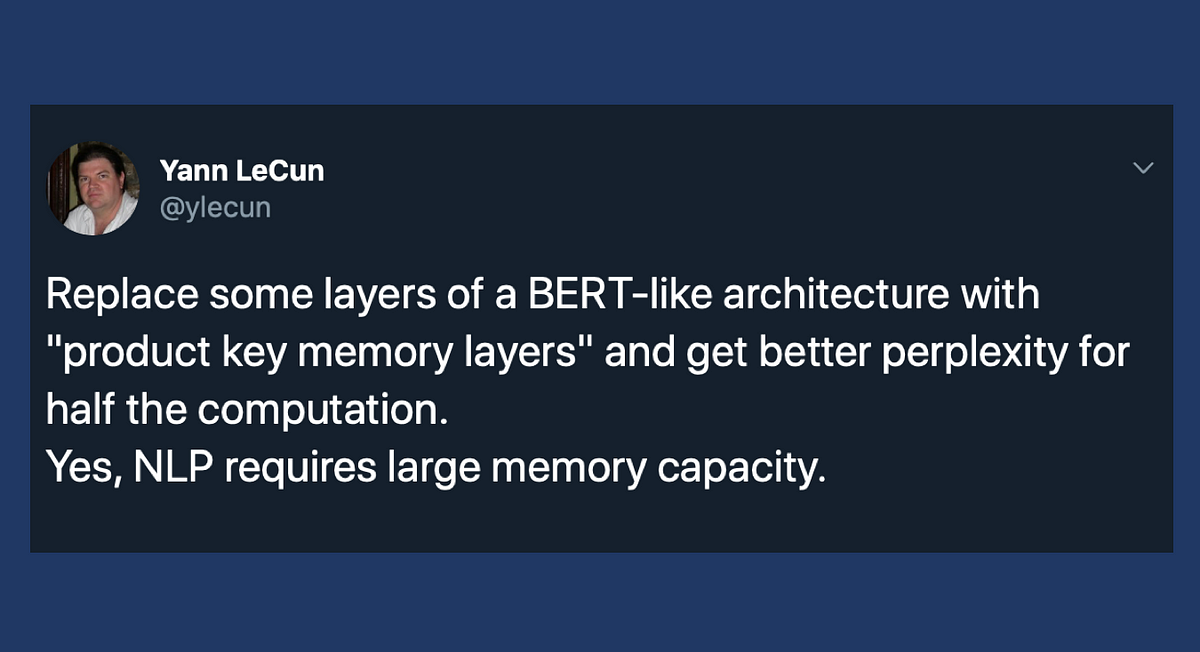
Neural networks are widely used in complex tasks such as machine translation, image classification, or speech recognition. These networks are data driven, and as the amount of data increases so does network size and the computational complexity required for training and inference. Recently, Facebook AI Research (FAIR) researchers introduced a structured memory layer which can be easily integrated into a neural network to greatly expand network capacity and the number of parameters without significantly changing calculation cost.

The approach is well-suited to natural language processing tasks, and the code has been open sourced on GitHub. The memory is very large by design and therefore significantly increases the capacity of the architecture, by up to a billion parameters with a negligible computational overhead. Its design and access pattern is based on product keys, which enable fast and exact nearest neighbor search.

The ability to increase the number of parameters while keeping the same computational budget lets the overall system strike a better trade-off between prediction accuracy and computation efficiency both at training and test time. This memory layer allows us to tackle very large scale language modeling tasks. In our experiments we consider a dataset with up to 30 billion words, and we plug our memory layer in a state-of-the-art transformer-based architecture.

In particular, we found that a memory augmented model with only 12 layers outperforms a baseline transformer model with 24 layers, while being twice faster at inference time. (Facebook AI Research).

Source: medium.com

Tags :
Share :
comments powered by Disqus

Related Posts

Releasing Pythia for vision and language multimodal AI models

Releasing Pythia for vision and language multimodal AI models

Pythia is a deep learning framework that supports multitasking in the vision and language domain. Built on our open-source PyTorch framework, the modular, plug-and-play design enables researchers to quickly build, reproduce, and benchmark AI models. Pythia is designed for vision and language tasks, such as answering questions related to visual data and automatically generating image captions.

Read More
Creating Bitcoin trading bots that don’t lose money

Creating Bitcoin trading bots that don’t lose money

In this article we are going to create deep reinforcement learning agents that learn to make money trading Bitcoin. In this tutorial we will be using OpenAI’s gym and the PPO agent from the stable-baselines library, a fork of OpenAI’s baselines library. If you are not already familiar with how to create a gym environment from scratch, or how to render simple visualizations of those environments, I have just written articles on both of those topics.

Read More
How to run evolution strategies on Google Kubernetes Engine

How to run evolution strategies on Google Kubernetes Engine

Reinforcement learning (RL) has become popular in the machine learning community as more and more people have seen its amazing performance in games, chess and robotics. In previous blog posts we’ve shown you how to run RL algorithms on AI Platform utilizing both Google’s powerful computing infrastructure and intelligently managed training service such as Bayesian hyperparameter optimization. In this blog, we introduce Evolution Strategies (ES) and show how to run ES algorithms on Google Kubernetes Engine (GKE).

Read More