Introducing LCA: Loss Change Allocation for Neural Network Training

Introducing LCA: Loss Change Allocation for Neural Network Training

  • September 14, 2019
Table of Contents

Introducing LCA: Loss Change Allocation for Neural Network Training

Neural networks (NNs) have become prolific over the last decade and now power machine learning across the industry. At Uber, we use NNs for a variety of purposes, including detecting and predicting object motion for self-driving vehicles, responding more quickly to customers, and building better maps. While many NNs perform quite well at their tasks, networks are fundamentally complex systems, and their training and operation is still poorly understood.

For this reason, efforts to better understand network properties and model predictions are ongoing, both at Uber and across the broader scientific community. Although prior studies have analyzed the network training process, it still largely remains a black box: millions of parameters are adjusted via simple rules during training, but our view into the process itself remains limited to a scalar loss quantity, which provides a severely restricted view into a rich and high-dimensional process. For example, it may be that one part of a network is performing all of the learning and another part is useless, but simply observing the loss will never reveal this.

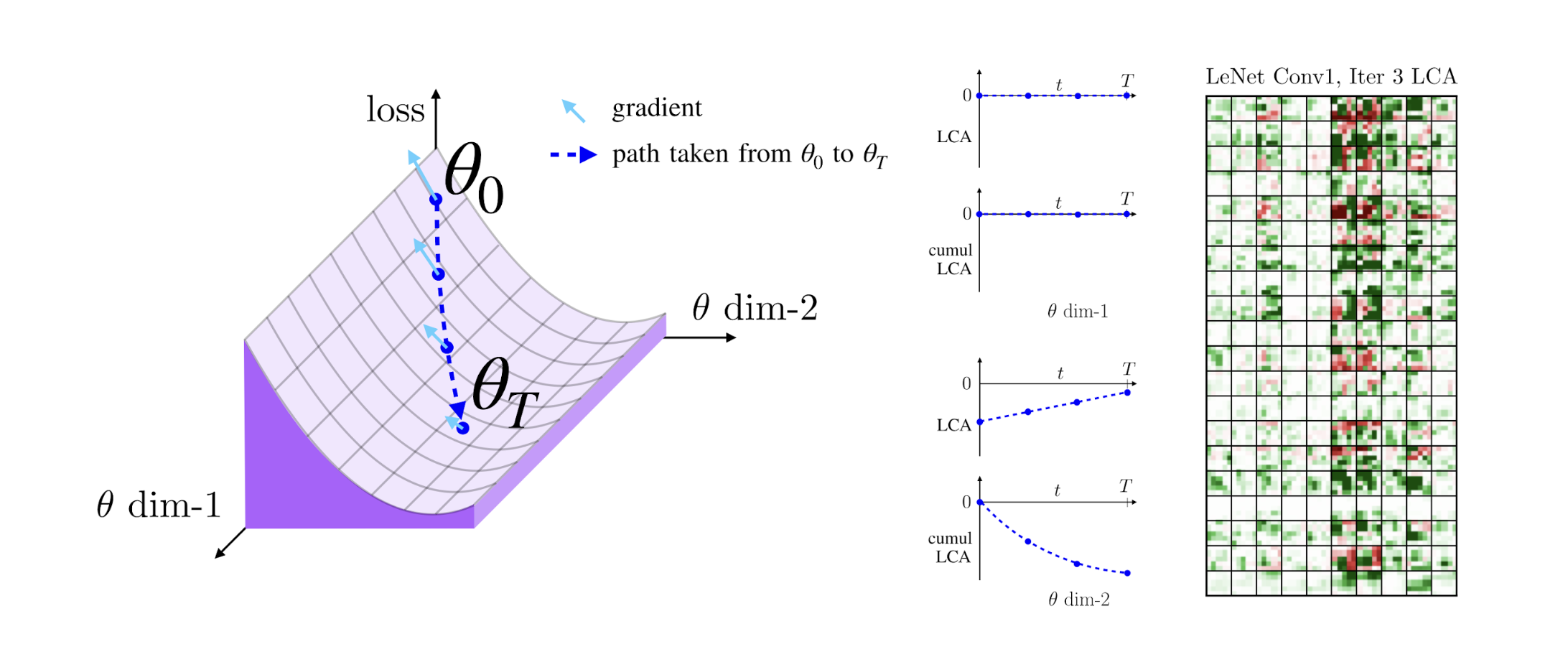
In our paper, LCA: Loss Change Allocation for Neural Network Training, to be presented at NeurIPS 2019, we propose a method called Loss Change Allocation (LCA) that provides a rich window into the neural network training process. LCA allocates changes in loss over individual parameters, thereby measuring how much each parameter learns. Using LCA, we present three interesting observations about neural networks regarding noise, layer contributions, and layer synchronization.

Fellow researchers and practitioners are invited to use our code to try this approach on their own networks.

Source: uber.com

Tags :
Share :
comments powered by Disqus

Related Posts

Replay in biological and artificial neural networks

Replay in biological and artificial neural networks

Our waking and sleeping lives are punctuated by fragments of recalled memories: a sudden connection in the shower between seemingly disparate thoughts, or an ill-fated choice decades ago that haunts us as we struggle to fall asleep. By measuring memory retrieval directly in the brain, neuroscientists have noticed something remarkable: spontaneous recollections, measured directly in the brain, often occur as very fast sequences of multiple memories. These so-called ‘replay’ sequences play out in a fraction of a second–so fast that we’re not necessarily aware of the sequence.

Read More
New advances in natural language processing

New advances in natural language processing

Natural language understanding (NLU) and language translation are key to a range of important applications, including identifying and removing harmful content at scale and connecting people across different languages worldwide. Although deep learning–based methods have accelerated progress in language processing in recent years, current systems are still limited when it comes to tasks for which large volumes of labeled training data are not readily available. Recently, Facebook AI has achieved impressive breakthroughs in NLP using semi-supervised and self-supervised learning techniques, which leverage unlabeled data to improve performance beyond purely supervised systems.

Read More
Powered by AI: Oculus Insight

Powered by AI: Oculus Insight

To unlock the full potential of virtual reality (VR) and augmented reality (AR) experiences, the technology needs to work anywhere, adapting to the spaces where people live and how they move within those real-world environments. When we developed Oculus Quest, the first all-in-one, completely wire-free VR gaming system, we knew we needed positional tracking that was precise, accurate, and available in real time — within the confines of a standalone headset, meaning it had to be compact and energy efficient. At last year’s Oculus Connect event we shared some details about Oculus Insight, the cutting-edge technology that powers both Quest and Rift S. Now that both of those products are available, we’re providing a deeper look at the AI systems and techniques that power this VR technology.

Read More