Performance monitoring with OpenTracing, OpenCensus, and OpenMetrics
If you are familiar with instrumenting applications, you may have heard of OpenMetrics, OpenTracing, and OpenCensus. These projects aim to create standards for application performance monitoring and collecting metric data. Although the projects do overlap in terms of their goals, they each take a different approach to observability and instrumentation.
Read More
Help! Something is wrong with my Jaeger installation!
Jaeger is composed of different components, each potentially running in its own host. It might be the case that one of these moving parts isn’t working properly, causing spans to not be processed and stored. When something goes wrong, make sure to check the items listed here.
Read More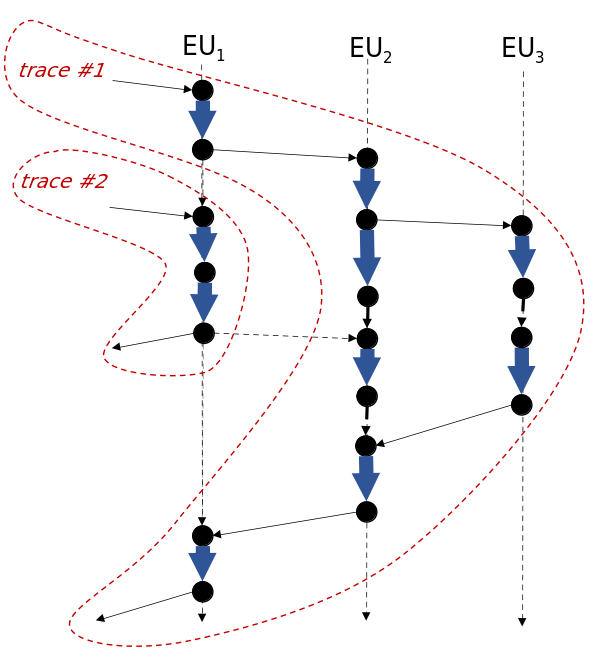
Open for event based tracing?
In OpenTracing the fundamental concept for representing distributed traces is the (time) span: something that starts and then finishes, can be annotated with key-value pairs and can be “causally” related. This representation gained popularity with Google’s Dapper paper and triggered open-source tracing implementations like Zipkin and Jaeger and eventually the OpenTracing specification, but according to the academic literature it is not the only one. In spite its popularity, the span based trace representation has some shortcomings that limit its applicability.
Read More
Deployment strategies for the Jaeger Agent
If you’ve been following the evolution of the Kubernetes templates for Jaeger, you might have noticed an important change recently: the Jaeger Agent is not being deployed as a DaemonSet anymore. Instead, instructions are now being provided on how to deploy it as a “Sidecar”. The Agent component was developed to act as a “buffer” between the tracer and the collector.
Read More