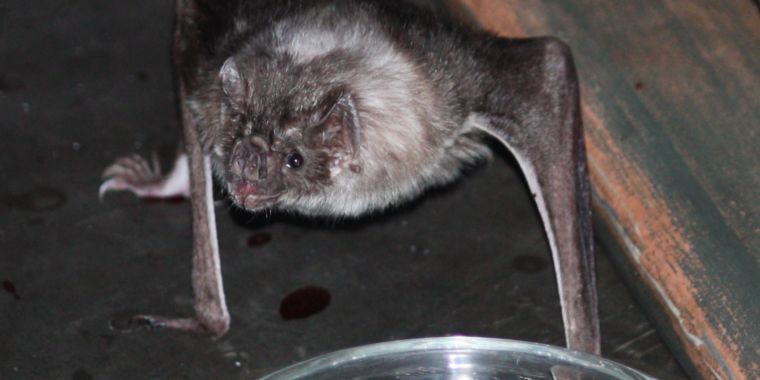
Gut bacteria key to the vampire bat’s ability to survive on blood

Gut bacteria key to the vampire bat’s ability to survive on blood

  • March 2, 2018
Table of Contents

Gut bacteria key to the vampire bat’s ability to survive on blood

Only three mammalian species are sanguivorous—that’s blood feeding—and they are all bats. Blood, apparently, is not that nutritious. It has almost no carbs, fats, or vitamins; its high iron levels can disrupt heart, liver, and pancreas function; its obscenely high protein and salt levels can cause renal disease if nitrogenous waste products build up.

It contains pathogens. It clots.

Source: arstechnica.com

Share :
comments powered by Disqus

Related Posts

Western science catching up to Indigenous Traditional Knowledge

Western science catching up to Indigenous Traditional Knowledge

The latest discovery has taken this assessment to new heights, literally. A team of researchers led by Mark Bonta and Robert Gosford in northern Australia has documented kites and falcons, colloquially termed “firehawks,” intentionally carrying burning sticks to spread fire. While it has long been known that birds will take advantage of natural fires that cause insects, rodents and reptiles to flee and thus increase feeding opportunities, that they would intercede to spread fire to unburned locales is astounding.

Read More
Probabilistic Programming and Bayesian Methods for Hackers

Probabilistic Programming and Bayesian Methods for Hackers

Bayesian Methods for Hackers is designed as a introduction to Bayesian inference from a computational/understanding-first, and mathematics-second, point of view. Of course as an introductory book, we can only leave it at that: an introductory book. For the mathematically trained, they may cure the curiosity this text generates with other texts designed with mathematical analysis in mind.

Read More
Long Term Depression Permanently Changes the Brain

Long Term Depression Permanently Changes the Brain

New brain imaging research from the Centre for Addiction and Mental Health (CAMH) shows that the brain alters after years of persistent depression, suggesting the need to change how we think about depression as it progresses.

Read More