World War II carrier “Lady Lex” found 2 miles under sea by Allen expedition

World War II carrier “Lady Lex” found 2 miles under sea by Allen expedition

  • March 7, 2018
Table of Contents

World War II carrier “Lady Lex” found 2 miles under sea by Allen expedition

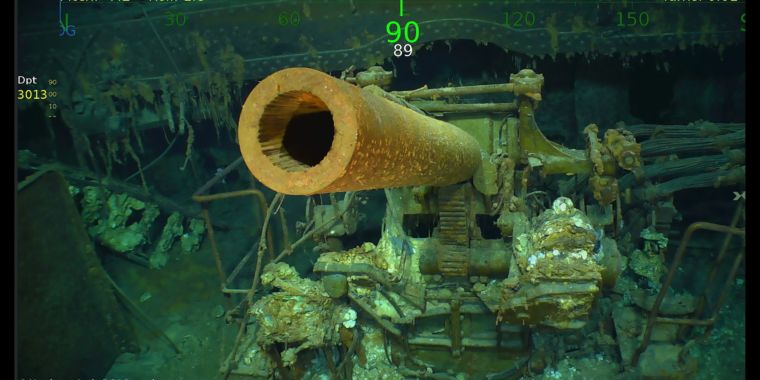
Paul Allen, the co-founder of Microsoft, has put his money into many passion pursuits. Underwater archaeology—specifically, finding ships sunk during World War II—is one of the most prominent.  Last August, Allen’s research vessel Petrel discovered the wreckage of the USS Indianapolis, the cruiser that delivered components of the two nuclear bombs dropped on Japan to close the war.

A 2015 Allen expedition on his personal yacht Octopus recovered a bell from the HMS Hood, the Royal Navy cruiser sunk by the German battleship Bismarck that led to the loss of over 1,400 men. The expedition also surveyed the wrecks of ‘Ironbottom Sound’ off Guadalcanal—the site of massive losses by the Allied navies during the long battle for that island.

Source: arstechnica.com

Share :
comments powered by Disqus

Related Posts

DNA Sheds Light On Settlement of Pacific

DNA Sheds Light On Settlement of Pacific

Two genetic studies shed light on the epic journeys that led to the settlement of the vast Pacific region by humans.

Read More
New study tracks the evolution of stone tools

New study tracks the evolution of stone tools

For at least 2.6 million years, humans and our ancestors have been making stone tools by chipping off flakes of material to produce sharp edges. We think of stone tools as very rudimentary technology, but producing a usable tool without wasting a lot of stone takes skill and knowledge. That’s why archaeologists tend to use the complexity of stone tools as a way to measure the cognitive skills of early humans and the complexity of their cultures and social interactions.

Read More
The Birth of A.I.

The Birth of A.I.

Waze famously disrupted GPS navigation by crowdsourcing user data from mobile phones, instead of purchasing costly sensors tied to city infrastructure, as Nokia had done before them. Waze then scaled with low overhead costs by using machine learning algorithms to find precise traffic patterns that optimized each user’s route. The end result of this dynamic was massive layoffs at Nokia, and Google’s acquisition of / integration with Waze in 2013.

Read More