Why and how GitLab abandoned Microsoft Azure for Google Cloud

Why and how GitLab abandoned Microsoft Azure for Google Cloud

  • April 7, 2018
Table of Contents

Why and how GitLab abandoned Microsoft Azure for Google Cloud

GitLab chose to move because it’s adopting Kubernetes, an open source project initially released by Google that’s designed to help companies manage applications composed of multiple software containers. It’s a move CEO Sid Sijbrandij said the company’s engineers welcomed with open arms. In his view, Google offers superior performance at a better price than other cloud providers.

Source: venturebeat.com

Share :
comments powered by Disqus

Related Posts

Alibaba cloud climbs to top 5

Alibaba cloud climbs to top 5

Last week Chinese eCommerce giant Alibaba announced its Q3 earnings. Cloud revenue was $553 million, an impressive 104 percent year-over-year increase. That comes out to a run rate in the range of $2.2 billion, well behind Google which announced it is pulling in a billion dollars a quarter and still buried behind the market leaders all of whom reported around $4 billion+ a quarter.

Read More
Google Unveils 72-Qubit Quantum Computer With Low Error Rates

Google Unveils 72-Qubit Quantum Computer With Low Error Rates

If a quantum processor can be operated with low enough error, it would be able to outperform a classical supercomputer on a well-defined computer science problem, an achievement known as quantum supremacy. These random circuits must be large in both number of qubits as well as computational length (depth). Although no one has achieved this goal yet, we calculate quantum supremacy can be comfortably demonstrated with 49 qubits, a circuit depth exceeding 40, and a two-qubit error below 0.5%.

Read More
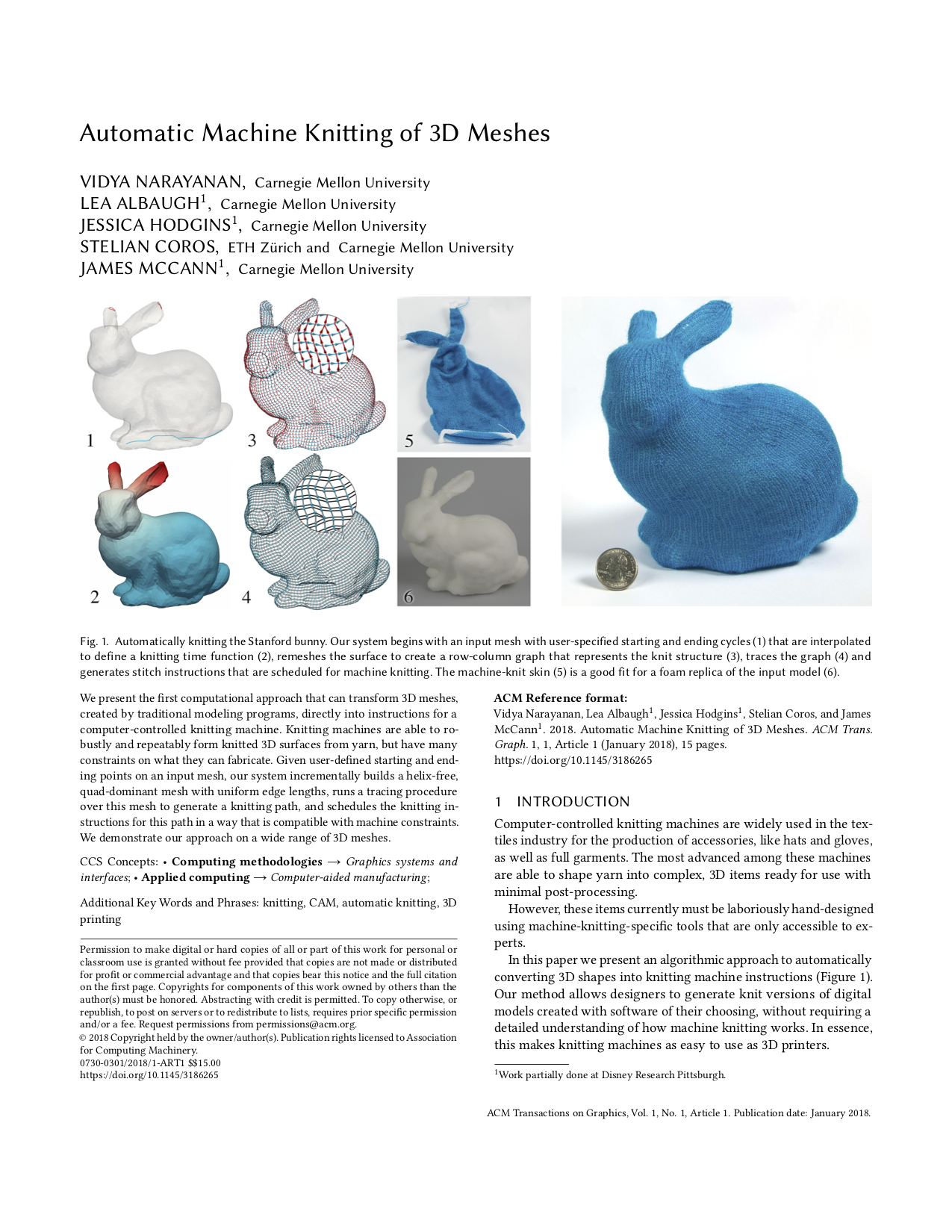
Automatic Machine Knitting of 3D Meshes

Automatic Machine Knitting of 3D Meshes

We present the first computational approach that can transform 3D meshes, created by traditional modeling programs, directly into instructions for a computer-controlled knitting machine. Knitting machines are able to robustly and repeatably form knitted 3D surfaces from yarn, but have many constraints on what they can fabricate.

Read More