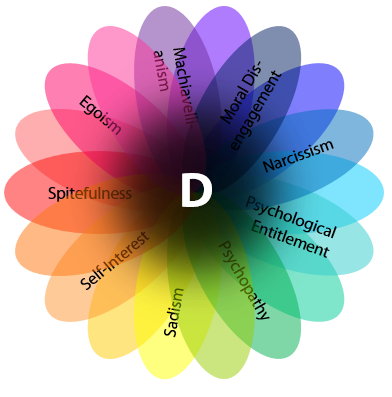
D: The Dark Factor of Personality
Table of Contents
Ethically, morally, and socially questionable behavior is part of everyday life and instances of ruthless, selfish, unscrupulous, or even downright evil behavior can easily be found across history and cultures. Psychologists use the umbrella term âdark traitsâ to subsume personality traits that are linked to these classes of behavior â most prominently, Machiavellianism, Narcissism, and Psychopathy. Over the years, more and more allegedly distinct and increasingly narrow dark traits have been introduced, resulting in a plethora of constructs lacking theoretical integration.
In proposing D â the Dark Factor of Personality â we specify the basic principles underlying all dark traits and thereby provide a unifying, comprehensive theoretical framework for understanding dark personality. In analogy to the general (g) factor of intelligence, D represents the one basic general dispositional tendency of which specific dark traits arise as manifestations. All commonalities between various dark traits can thus be traced back to D, so that D represents the common core of all dark traits.
Source: darkfactor.org