Ion drive meets drone, as small plane flies with no moving parts

Ion drive meets drone, as small plane flies with no moving parts

  • November 22, 2018
Table of Contents

Ion drive meets drone, as small plane flies with no moving parts

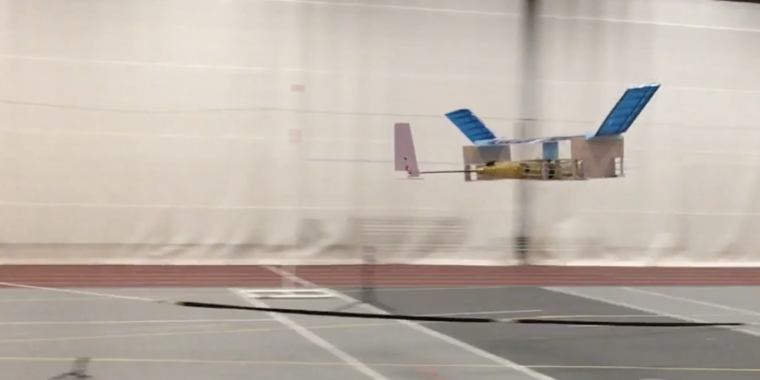
The Johnson Indoor Track at MIT probably won’t go down in history in the same way as Kitty Hawk has, but it was the scene of a first in powered flight. A team of researchers has managed to build the first aircraft powered by an ionic wind, a propulsion system that requires no moving parts. While the flight took place using a small drone, the researchers’ calculations suggest that the efficiency of the design would double simply by building a larger craft.

In conventional aircraft, air is pushed around by moving parts, either propellers or the turbines within jet engines. But we’ve known for a while that it’s also possible to use electrical fields to push air around. The challenge is that air is largely made of uncharged molecules that don’t respond to electric fields.

But at sufficiently high voltages, it’s possible to ionize the nitrogen and oxygen that make up our atmosphere, just as lightning does all the time. The electrons that are liberated speed away, collide with other molecules, and ionize some of them as well. If this takes place in an electric field, all those ions will start moving to the appropriate electrode.

In the process, they’ll collide with neutral molecules and push them along. The resulting bulk movement of atmospheric molecules is called an ionic wind.

Source: arstechnica.com

Tags :
Share :
comments powered by Disqus

Related Posts

Drone crashes in Arizona National Forest, starts a wildfire

Drone crashes in Arizona National Forest, starts a wildfire

Drone use and wilderness areas have been in conflict in recent years. Drones have grounded fire-fighting planes and helicopters, which usually fly low to the forest. Having a drone come in contact with propellers could endanger a firefighter’s life.

Read More
How Do Drone Light Shows Work?

How Do Drone Light Shows Work?

MRS is a new initiative of the IEEE RAS Technical Committee on Multi-Robot Systems, and it’s intended to bring together researchers who are in the field of multi-robot systems (MRS) and multi-agent systems (MAS). “Typically MRS/MAS research is spread across large conferences, so the intent of this more focused conference is to bring those researchers together to highlight the best in the field and learn more from each other,” said Dr. Nora Ayanian, Assistant Professor and Director of the ACT Lab at USC and MRS chair.

Read More
Drone Delivery Becomes a Reality in Remote Pacific Islands

Drone Delivery Becomes a Reality in Remote Pacific Islands

Currently, health workers in Vanuatu often hike over mountains to deliver vaccines–but drones can fly over them. This September, delivery drones will begin to fly the friendly skies of Vanuatu. And this isn’t a one-shot demonstration, like many of the stunts we’ve seen from the likes of Amazon and Google.

Read More