Radiology and Deep Learning

Radiology and Deep Learning

  • November 27, 2018
Table of Contents

Radiology and Deep Learning

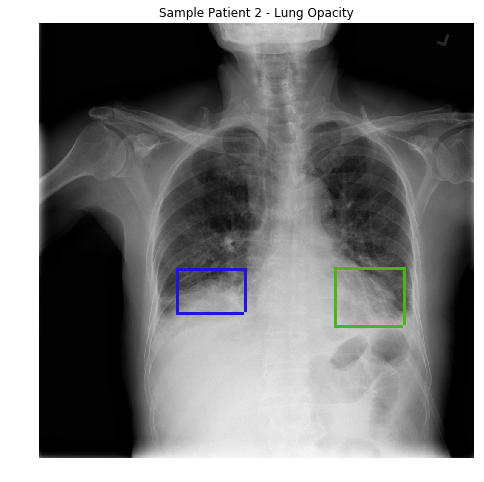
Radiology and DeepLearningDetecting pneumonia opacities from chest X-Ray images using deep learning. One day back in August, I was catching up with my best friend from high school who is now a radiology resident. One thing led to another, and we started talking about our interests in artificial intelligence and machine learning and its possible applications in radiology.

A couple of months after our talk, I stumbled upon a Kaggle challenge hosted by the Radiological Society of North American (RSNA). It was a competition that we could work on together, so I immediately called my friend. Joined by my brother, we formed a team to compete in this Kaggle challenge.

After a month of hard work, we ended up finishing in the top 3%. In this blog post, I’d like to detail what we did during the exciting month. One day back in August, I was catching up with my best friend from high school who is now a radiology resident.

One thing led to another, and we started talking about our interests in artificial intelligence and machine learning and its possible applications in radiology. A couple of months after our talk, I stumbled upon a Kaggle challenge hosted by the Radiological Society of North American (RSNA). It was a competition that we could work on together, so I immediately called my friend.

Joined by my brother, we formed a team to compete in this Kaggle challenge. After a month of hard work, we ended up finishing in the top 3%. In this blog post, I’d like to detail what we did during the exciting month.

Source: medium.com
Share :
comments powered by Disqus

Related Posts

Five Lessons From the First Three Years of Michelangelo

Five Lessons From the First Three Years of Michelangelo

Uber has been one of the most active contributors to open source machine learning technologies in the last few years. While companies like Google or Facebook have focused their contributions in new deep learning stacks like TensorFlow, Caffe2 or PyTorch, the Uber engineering team has really focused on tools and best practices for building machine learning at scale in the real world. Technologies such as Michelangelo, Horovod, PyML, Pyro are some of examples of Uber’s contributions to the machine learning ecosystem.

Read More
Real Time Facial Expression Recognition

Real Time Facial Expression Recognition

Computer animated agents and robots bring new dimension in human computer interaction which makes it vital as how computers can affect our social life in day-to-day activities. Face to face communication is a real-time process operating at a time scale in the order of milliseconds. The level of uncertainty at this time scale is considerable, making it necessary for humans and machines to rely on sensory rich perceptual primitives rather than slow symbolic inference processes.

Read More
Accurate Online Speaker Diarization with Supervised Learning

Accurate Online Speaker Diarization with Supervised Learning

Speaker diarization, the process of partitioning an audio stream with multiple people into homogeneous segments associated with each individual, is an important part of speech recognition systems. By solving the problem of “who spoke when”, speaker diarization has applications in many important scenarios, such as understanding medical conversations, video captioning and more. However, training these systems with supervised learning methods is challenging — unlike standard supervised classification tasks, a robust diarization model requires the ability to associate new individuals with distinct speech segments that weren’t involved in training.

Read More