Making the LinkedIn experimentation engine 20x faster

Making the LinkedIn experimentation engine 20x faster

  • January 23, 2020
Table of Contents

Making the LinkedIn experimentation engine 20x faster

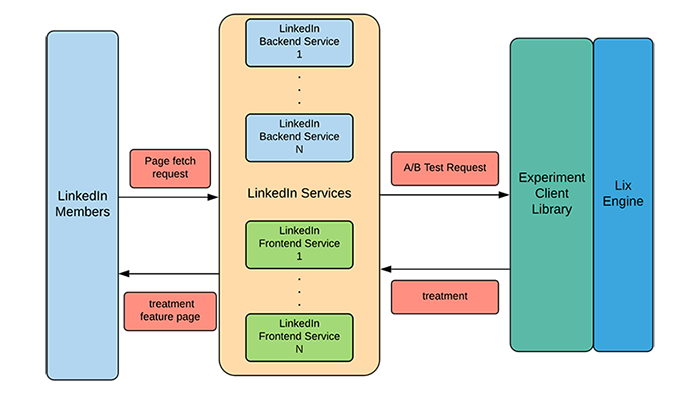
At LinkedIn, we like to say that experimentation is in our blood because no production release at the company happens without experimentation; by “experimentation,” we typically mean “A/B testing.” The company relies on employees to make decisions by analyzing data. Experimentation is a data-driven foundation of the decision-making process, which helps with measuring the precise impact of every change and release, and evaluating whether expectations meet reality.

LinkedIn’s experimentation platform operates at an extremely large scale: It serves up to 800,000 QPS of network calls, It serves about 35,000 concurrently running A/B experiments, It handles up to 23 trillion experiment evaluations per day, Average latency of experiment evaluation is 700 ns and the 99th percentile is 3 μs, It is used in about 500 production services. It is used in about 500 production services.

Source: linkedin.com

Share :
comments powered by Disqus

Related Posts

Database Migration To Amazon Aurora

Database Migration To Amazon Aurora

In this blog post we’ll show you how we migrated a critical Postgres database with 18Tb of data from Amazon RDS (Relational Database Service) to Amazon Aurora, with minimal downtime. To do so, we’ll discuss our experience at Codacy.

Read More
Cape Technical Deep Dive

Cape Technical Deep Dive

In this post, we’ll take a deep dive into the design of the Cape framework. First, we’ll discuss Cape’s architecture. Then we’ll look at the core scheduling component of the system.

Read More
Automating Datacenter Operations at Dropbox

Automating Datacenter Operations at Dropbox

Switch provisioning at Dropbox is handled by a Pirlo component called the TOR Starter. The TOR Starter is responsible for validating and configuring switches in our datacenter server racks, PoP server racks, and at the different layers of our datacenter fabric that connect racks in the same facility together. Writing the TOR Starter on top of the ClusterOps queue provides us with a basic manager-worker queuing service.

Read More