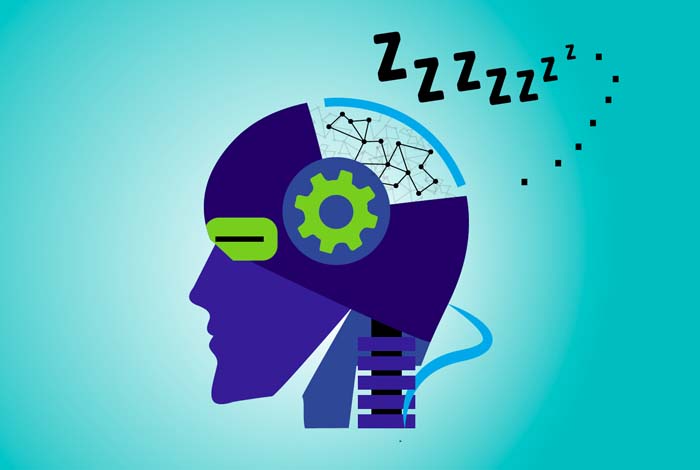
Artificial brains may need sleep too

Artificial brains may need sleep too

  • June 10, 2020
Table of Contents

Artificial brains may need sleep too

No one can say whether androids will dream of electric sheep, but they will almost certainly need periods of rest that offer benefits similar to those that sleep provides to living brains, according to new research from Los Alamos National Laboratory. Watkins and her research team found that the network simulations became unstable after continuous periods of unsupervised learning. When they exposed the networks to states that are analogous to the waves that living brains experience during sleep, stability was restored.

“It was as though we were giving the neural networks the equivalent of a good night’s rest,” said Watkins. The discovery came about as the research team worked to develop neural networks that closely approximate how humans and other biological systems learn to see. The group initially struggled with stabilizing simulated neural networks undergoing unsupervised dictionary training, which involves classifying objects without having prior examples to compare them to.

Source: lanl.gov

Tags :
Share :
comments powered by Disqus

Related Posts

Top 10 Best FREE Artificial Intelligence Courses

Top 10 Best FREE Artificial Intelligence Courses

Most of the Machine Learning, Deep Learning, Computer Vision, NLP job positions, or in general every Artificial Intelligence (AI) job position requires you to have at least a bachelor’s degree in Computer Science, Electrical Engineering, or some similar field. If your degree comes from some of the world’s best universities than your chances might be higher in beating the competition on your job interview. But looking realistically, not most of the people can afford to go to the top universities in the world simply because not most of us are geniuses and don’t have thousands of dollars, or come from some poor country (like we do).

Read More
The Hateful Memes AI Challenge

The Hateful Memes AI Challenge

We’ve built and are now sharing a data set designed specifically to help AI researchers develop new systems to identify multimodal hate speech. This content combines different modalities, such as text and images, making it difficult for machines to understand. The Hateful Memes data set contains 10,000+ new multimodal examples created by Facebook AI.

Read More