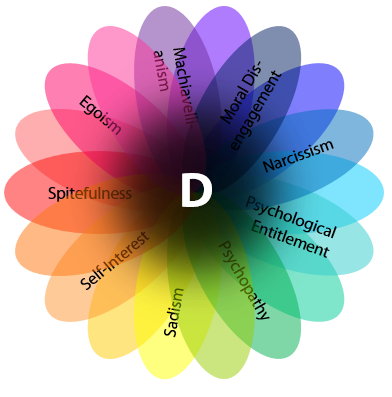
D: The Dark Factor of Personality
Ethically, morally, and socially questionable behavior is part of everyday life and instances of ruthless, selfish, unscrupulous, or even downright evil behavior can easily be found across history and cultures. Psychologists use the umbrella term âdark traitsâ to subsume personality traits that are linked to these classes of behavior â most prominently, Machiavellianism, Narcissism, and Psychopathy. Over the years, more and more allegedly distinct and increasingly narrow dark traits have been introduced, resulting in a plethora of constructs lacking theoretical integration.
Read More

On Cumulative Advantage and How to Think About Luck
In the late 1970s the view in the publishing world was that an author should never produce more than one book a year. The thinking was that publishing more than one book a year would dilute the brand name of the author. However, this was a bit of a problem for Stephen King, who was writing books at a rate of two per year.
Read More
The emotions we feel may shape what we see
Our emotional state in a given moment may influence what we see, according to findings published in Psychological Science, a journal of the Association for Psychological Science. In two experiments, researchers found that participants saw a neutral face as smiling more when it was paired with an unseen positive image.
Read More
Why symmetry gets really interesting when it is broken
A hypothetical alien visitor, sent to observe all of human culture – art and architecture, music and medicine, storytelling and science – would quickly conclude that we as a species are obsessed with patterns. The formal gardens of 18th-century England, the folk tales of medieval Germany and the traditional woven fabrics of Mayan civilisation have little in common, but they each owe their aesthetic appeal to being composed of smaller, identical parts arranged into a harmonious whole.
Read More
Can a Wandering Mind Make You Neurotic?
On the positive side, mind-wandering promotes planning for the future, allowing my daughter to lay the groundwork for financial security and a career with a long endgame. And it may be an essential ingredient in creativity. Several studies have shown that creativity blossoms under the same conditions that encourage mind-wandering—for example, an incubation period in which the mind is only lightly focused on an easy task is especially conducive to flashes of insight and imaginative solutions to problems.
Read More
Ratings inflation on Uber and elsewhere
Uber asks riders to give their drivers a rating of one to five stars at the end of each trip. But very few people make use of this full scale. That’s because it’s common knowledge among Uber’s users that drivers need to maintain a certain minimum rating to work, and that leaving anything less than five stars could jeopardize their status.
Read More




Social Inequality Leaves a Genetic Mark
In humans, the profound biological differences that exist between the sexes mean that a single male is physically capable of having far more children than is a single female. Women carry unborn children for nine months and often nurse them for several years prior to having additional children. Men, meanwhile, are able to procreate while investing far less time in the bearing and early rearing of each child.
Read More
The Key to Good Luck Is an Open Mind
What do these people have that the rest of us don’t? It turns out “ability” is the key word here. Beyond their level of privilege or the circumstances they were born into, the luckiest people may have a specific set of skills that bring chance opportunities their way.
Read More

Your Speech Is Packed With Misunderstood, Unconscious Messages
Imagine standing up to give a speech in front of a critical audience. As you do your best to wax eloquent, someone in the room uses a clicker to conspicuously count your every stumble, hesitation, um and uh; once you’ve finished, this person loudly announces how many of these blemishes have marred your presentation.
Read More
Unhappiness Is a Palate-Cleanser
Happiness, in one form or another, seems to be a common goal that most of us would like to attain. We often behave as though we might find a route to contentment—comfort, satiety, warmth, or some other reward—and be happy all the time if we could just make the right choices. But pleasure is often fleeting, even from the most appealing experiences, giving rise to ennui and sparking the drive for something new and sensational.
Read More
Studying how the brain relinquishes childhood memories
We called them fairy rocks. They were just colorful specks of gravel—the kind you might buy for a fish tank—mixed into my preschool’s playground sand pit. But my classmates and I endowed them with magical properties, hunted them like treasure, and carefully sorted them into piles of sapphire, emerald, and ruby.
Read More
Our dreams have many purposes, changing across the lifespan
Dreams differ not only across a single lifetime or a single night, they also differ dramatically across historical epochs. The dreams of the ancient Greeks and Romans, and indeed the dreams of most peoples of the ancient world, were viewed as direct portals into the spirit world and the realm of the ancestors and gods. Ancient peoples (and traditional peoples even today) often experienced dreams as the place to conduct a transaction with a spirit being who could significantly help or hinder you in your daily affairs.
Read More
The forgetting curve explains why humans struggle to memorize
Learning has an evolutionary purpose: Among species, individuals that adapt to their environments will succeed. That’s why your brain more easily retains important or surprising information: It takes very little effort to remember that the neighbor’s dog likes to bite. Remembering the dog’s name is harder.
Read More
Hacking the Brain with Adversarial Images
This is an example of what’s called an adversarial image: an image specifically designed to fool neural networks into making an incorrect determination about what they’re looking at. Researchers at Google Brain decided to try and figure out whether the same techniques that fool artificial neural networks can also fool the biological neural networks inside of our heads, by developing adversarial images capable of making both computers and humans think that they’re looking at something they aren’t.
Read More
The Bayesian Probability Puzzle Solution
When making hard decisions, do you go with your gut or try to calculate the risks? In many cases going with your gut is fine, but the answers to our February puzzle problems show how explicit probabilistic thinking can outperform intuitive estimates. They also highlight the differences between situations where an intuitive approach succeeds and ones where it fails.
Read More